Spirituality · / /
Everything You Think You Choose Was Already Chosen For You
#8 - Your Existence Is Mathematically Impossible — Which Proves It Was Predetermined
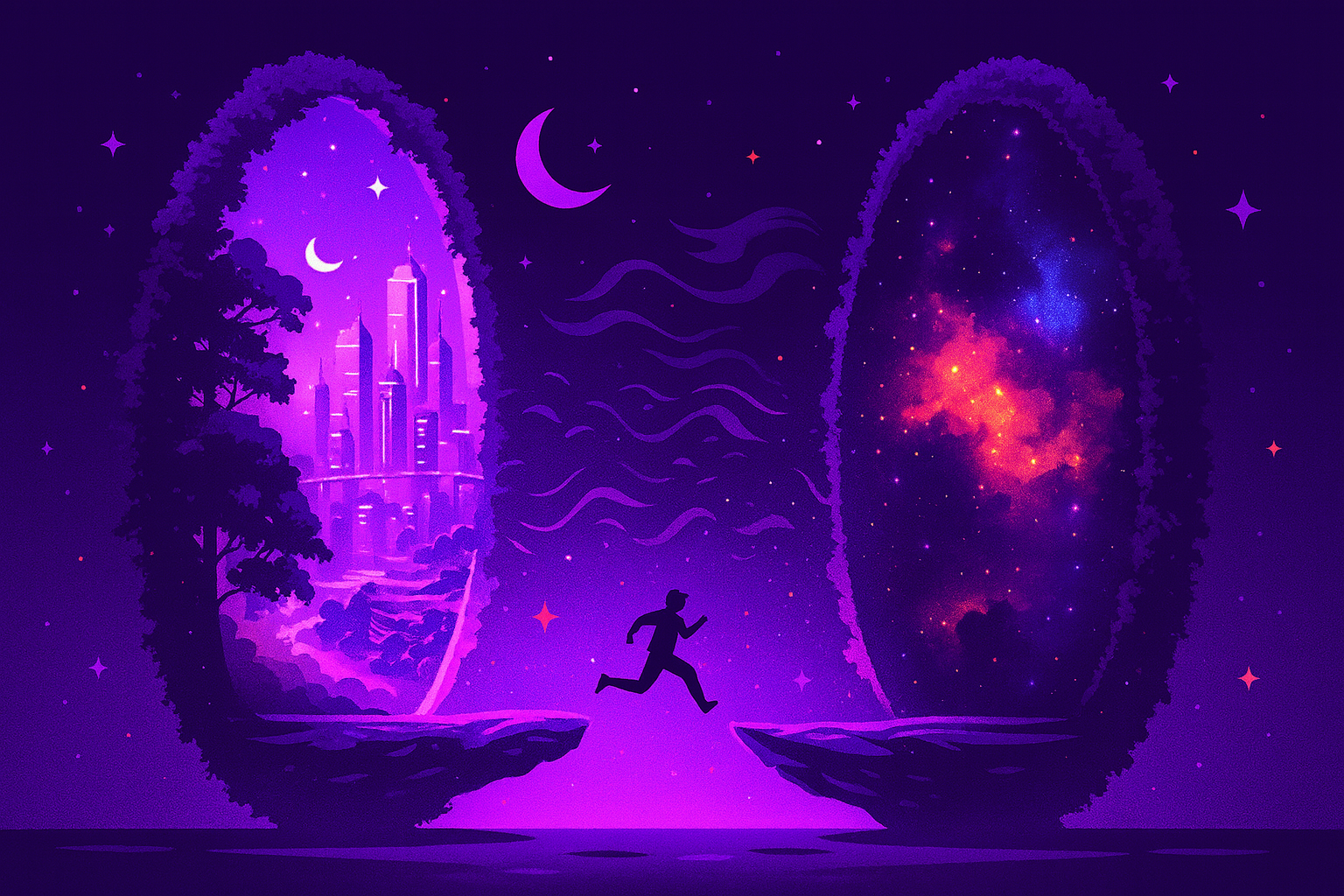
There is something I want you to consider.
I was scrolling through a carousel recently—one of those posts that tries to make you feel contemplative by showing you how improbable your existence is.
The probability of Earth being positioned exactly where it is. The Moon is at precisely the right distance to stabilize our tilt. The Sun with its exact mass and energy output. Jupiter’s gravitational field acts as a cosmic shield, deflecting asteroids that would have ended life millions of years ago. The chain of your ancestors—thousands of generations—surviving disease, famine, predators, wars, and countless near-extinctions, each one making decisions that led directly to you.
When you stack all of these probabilities together, the mathematics becomes absurd. The chance of you existing is not low—it is effectively zero.
And yet, here you are. Reading these words. Breathing. Conscious. Alive.
This bothered me. Not the improbability—but what it implies.
The Only Logical Conclusion
Think about this carefully.
If the probability of any event is virtually zero, then that event should not happen. That’s what zero means. It is the absence of possibility. It is a mathematical certainty that something will not occur.
And yet—everything is occurring. You are here. I am here. The universe is here. Billions of humans across thousands of years, each one an impossibility, all existing simultaneously.
When something that cannot happen is happening, you are left with only two conclusions:
One: Mathematics is wrong, and probability means nothing. Impossible things happen constantly for no reason. The universe is pure chaos, pure randomness, a cosmic accident repeated endlessly for no purpose.
Two: Nothing is happening by chance. The zero-probability events occurring around you are not accidents. They were always meant to happen. They could not have not happened. Everything you see—everything you experience—was predetermined by a will that exists outside the boundaries of this universe.
The first option is not just nihilistic—it is irrational. If probability is meaningless, then science itself collapses. We cannot predict anything. We cannot understand anything. The very concept of cause and effect becomes absurd.
The second option is the only coherent one.
If mathematically impossible events are occurring, then those events were not subject to chance. They were determined.
What the Quran Already Knew
Fourteen centuries ago, the Quran stated this with absolute clarity:
إِنَّا كُلَّ شَىْءٍ خَلَقْنَـٰهُ بِقَدَرٍ
“Indeed, We have created everything according to a predestined measure.”
— Surah Al-Qamar (54:49)
Not some things. Not most things. Everything.
The Arabic word qadr (قَدَر) does not simply mean fate in the passive sense—it means precise measurement, exact proportion, divinely calibrated design. Every atom, every moment, every decision—measured and placed with intention.
The Quran goes further:
مَآ أَصَابَ مِن مُّصِيبَةٍ فِى ٱلْأَرْضِ وَلَا فِىٓ أَنفُسِكُمْ إِلَّا فِى كِتَـٰبٍ مِّن قَبْلِ أَن نَّبْرَأَهَآ
“No disaster strikes upon the earth or among yourselves except that it is written in a register before We bring it into being.”
— Surah Al-Hadid (57:22)
Before the universe existed. Before time began. Before you were born. It was already written.
This is not a comforting platitude. This is a statement of metaphysical fact. And it aligns perfectly with what the mathematics of probability already proves: if you exist despite having a zero chance of existing, then your existence was never subject to probability in the first place.
You were always meant to be here.
The Illusion of Ownership
Now, this creates a problem.
If everything is predetermined, do we have free will?
The answer is both simpler and more profound than the question allows.
You experience choice. Right now, you could stop reading this article. You could continue. You could agree with what I’m saying. You could reject it. You feel the weight of decision in every moment.
That feeling is real. You are not imagining it. The sense that you are the one making the choice—that is genuinely how you experience reality.
But here is the distinction that matters: you experience choice, but you do not own it.
When you wake up tomorrow morning and decide to do pushups instead of checking your phone, you feel like you are making that decision. And in a very real sense, you are. Your consciousness is the location where that choice is happening. Your will is the mechanism through which it manifests.
But that decision was already written. You only chose what was already chosen for you. You are not the author of the decision—you are the experiencer of it.
Think of it this way: when you read a novel, the characters feel real. They seem to make choices. They struggle, they grow, they change. But every word they speak was already written before you opened the book. Their “choices” were determined by the author. The characters experience agency—but they do not own the story.
You are experiencing agency. But you do not own the story.
وَمَا تَشَآءُونَ إِلَّآ أَن يَشَآءَ ٱللَّهُ
“And you do not will except that Allah wills.”
— Surah At-Takwir (81:29)
You will. You choose. You decide. But your will operates within His will. Your choice is a subset of His choice. You cannot want something He did not already want you to want.
This is not oppression. This is reality.
The Question That Haunts Us
And now we arrive at the question that has driven countless people away from faith.
If we do not truly own our choices—if everything we do was already predetermined before we were born—then why would God punish us for sin?
This is the question of theodicy dressed in the clothes of determinism. And it has broken many hearts.
They say: “If I was destined to sin, how can I be blamed for sinning? If I never had real freedom, how can I be held accountable for what I could not control?”
This question assumes something false. It assumes that accountability requires absolute ownership—that you must be the ultimate author of your actions to be judged for them.
But consider this more carefully.
You experienced the choice. In the moment of decision, you felt the weight of it. You knew what was right. You knew what was wrong. You chose anyway. That experience was real. The recognition was real. The decision as you lived it was real.
Accountability is not for abstract metaphysical authorship. Accountability is for recognition.
When you stood at the crossroads, you saw the truth. You recognized the right path. And you turned away. That recognition—that moment of seeing and choosing otherwise—is what you are accountable for.
The Quran makes this precise:
وَهَدَيْنَـٰهُ ٱلنَّجْدَيْنِ
“And We have shown him the two ways.”
— Surah Al-Balad (90:10)
God does not punish you for being predetermined. He accounts for what you recognized. You saw the two paths. You knew which one led to light. What did you do?
That is the question.
The Cosmological Key
But we still have not answered why. Why does this universe exist with its suffering and sin? Why does evil happen at all? If God is good and God is sovereign, why is there so much darkness?
This is where we arrive at something profound.
Before creation, there was only God.
The One. Al-Ahad. Absolute unity. No opposite, no duality, no contrast. God’s existence does not contain pairs. His attributes point toward oneness—complete, undivided, infinite.
Then God created.
And the moment He created, duality entered existence.
وَمِن كُلِّ شَىْءٍ خَلَقْنَا زَوْجَيْنِ
“And of all things We created pairs.”
— Surah Adh-Dhariyat (51:49)
This is the definition of creation itself. Creation is the world of two.
Day and night. Light and shadow. Male and female. Up and down. Joy and sorrow. Good and evil. Truth and falsehood.
The universe could not exist without polarity. Duality is not a flaw in creation—it is the signature of created reality. It is what distinguishes the created from the Creator.
God is One. Creation is Two.
And because creation is two, you cannot have one side without the other. You cannot have day without night. You cannot have peace without having known war. You cannot recognize good without having witnessed evil.
Evil is not an error in creation. It is a structural necessity of any created universe that contains consciousness.
For you to know what light is, you must have experienced darkness. For you to appreciate truth, you must have encountered lies. For you to love virtue, you must have seen what happens when virtue is absent.
The universe is in balance—not because everything is pleasant, but because polarity is the condition of existence. Light balances dark. Good balances evil. And your consciousness stands in the middle, witnessing both, recognizing the difference, choosing which side to align with.
Why This Had to Happen
Now trace this logic to its conclusion.
When God created Adam, He created him in Paradise. Perfect conditions. No suffering. No want. And God told him: Stay here. Be content. Do not approach that tree.
But God knew what would happen.
Because Adam was created. And created beings exist in duality. The moment consciousness emerged, the pole of disobedience emerged with it. Satan whispered. Adam reached. The fall happened.
Not because God failed to prevent it—but because this is what creation does. Created beings, by their nature, contain the capacity for both obedience and rebellion. That capacity is not a defect. It is the definition of what it means to be a conscious created being.
قَالَ ٱهْبِطُوا۟ مِنْهَا جَمِيعًۢا بَعْضُكُمْ لِبَعْضٍ عَدُوٌّ
“He said, ‘Descend from it, all of you, as enemies to one another.’”
— Surah Ta-Ha (20:123)
This descent was not punishment in the ordinary sense. It was manifestation. The duality that exists in all created consciousness had to express itself. Paradise could not hold beings who carry both light and shadow within them—not until they have been tested, refined, and returned to unity.
The fall was inevitable. Not because Adam was weak—but because he was created.
And created things must experience their duality before they can transcend it.
The Only Logical Response
So where does this leave you?
You exist in a universe you did not create. You make choices you do not own. You experience duality you cannot escape. Everything that happens—everything that has ever happened or will ever happen—was written before the universe began.
What can you do?
There is only one answer. And it is the same answer the Quran has been pointing toward from the beginning:
Surrender.
Not surrender as defeat. Not surrender as passive resignation. Not surrender as giving up.
Surrender as harmony.
Think of a feather falling through the air. The feather does not fight the wind. It does not try to fly on its own power. It does not resist the currents that carry it. It moves with the reality it finds itself in—gracefully, effortlessly, completely.
When you surrender to the will of God, you are not giving up your agency. You are aligning your agency with the force that created you. You stop fighting the current. You stop pretending you own the story. You stop exhausting yourself trying to be the author when you were always meant to be the reader.
This is the meaning of Islam itself. The word comes from aslama—to submit, to surrender, to enter into peace.
إِذْ قَالَ لَهُۥ رَبُّهُۥٓ أَسْلِمْ ۖ قَالَ أَسْلَمْتُ لِرَبِّ ٱلْعَـٰلَمِينَ
“When his Lord said to him, ‘Submit,’ he said, ‘I have submitted to the Lord of the worlds.’”
— Surah Al-Baqarah (2:131)
This was Ibrahim’s answer. When God asked him to walk into fire, he surrendered. When God asked him to leave his wife and infant son in an empty desert, he surrendered. When God asked him to sacrifice that same son years later, he raised the knife.
And every time—every single time—the fire became cool, the desert became Zamzam, the sacrifice was replaced with mercy.
Surrender is not the end of agency. It is the beginning of grace.
When you stop resisting the divine will—when you allow yourself to be carried like that feather—you move in harmony with the universe itself. The friction disappears. The struggle transforms. What felt like prison becomes protection. What felt like loss becomes liberation.
But Wait—There Is a Paradox
And here is where it gets truly deep.
You might say: “If everything is predetermined, then even my surrender is predetermined. I cannot choose to surrender unless God has already chosen for me to surrender. So what’s the point?”
You are right.
Even your act of surrender—that very moment when you stop resisting and allow yourself to be carried—was written before the universe began. You will only surrender if you were destined to surrender. You will only resist if you were destined to resist.
But here is the paradox that completes the logic:
You still have to do it.
You cannot sit back and say “Whatever is destined will happen” and use that as an excuse for passivity. The Prophet Muhammad ﷺ was asked this exact question: If everything is written, why should we act?
He answered:
اعْمَلُوا فَكُلٌّ مُيَسَّرٌ لِمَا خُلِقَ لَهُ
“Act, for everyone is facilitated toward what they were created for.”
— Sahih Bukhari
The predetermined outcome and your action are not in conflict. Your action is the predetermined outcome unfolding. You are not choosing instead of destiny—you are choosing as destiny. Your surrender is how the divine will manifests in your particular life.
When you say “I surrender,” you are not overriding the script. You are reading your line.
But you still must read it.
The Final Truth
So let me tell you what I know.
You are not here by accident. The mathematics proves it. The probability of your existence is zero, yet you exist. That means you were intended. You were designed. You were written into the story before the story began.
Everything that has happened to you—every joy, every tragedy, every choice you made and every consequence you suffered—was known before you drew your first breath. Nothing surprised God. Nothing escaped His knowledge. Nothing happened outside His will.
You experience choice. That experience is real. But you do not own the choices—you only navigate them. You are a conscious witness to a story already written, playing your role with the full weight of agency even though the ending is already known.
Evil exists because duality is the nature of creation. You cannot have light without shadow, good without evil, truth without falsehood. The darkness you see in the world is not a flaw in God’s design—it is the necessary contrast that allows you to recognize and choose the light.
And your response to all of this—the only rational, logical, spiritually coherent response—is surrender.
Not passive surrender. Not fatalistic surrender. But active, trusting, grace-filled surrender. Becoming like a feather in the wind. Aligning your will with the will of the One who wrote you into existence.
When you surrender completely, something miraculous happens. The fire becomes cool. The desert flows with water. The sacrifice is transformed into mercy. You move with the current instead of against it, and life becomes what it was always meant to be: an act of worship, a return to the One, a journey home.
And yes—even that surrender was predetermined. Even this moment, reading these words, feeling whatever you’re feeling—it was all written.
But you don’t have any other choice.
So surrender.
وَمَن يُسْلِمْ وَجْهَهُۥٓ إِلَى ٱللَّهِ وَهُوَ مُحْسِنٌ فَقَدِ ٱسْتَمْسَكَ بِٱلْعُرْوَةِ ٱلْوُثْقَىٰ
“And whoever submits his face to Allah while being a doer of good—he has indeed grasped the firmest handhold.”
— Surah Luqman (31:22)
Grasp it.
— Roohle
Stay with the work
A short letter, when there is something worth sending.
No schedule. No marketing. A note when a new piece is published, sometimes a passage being worked through, occasionally nothing for weeks. Roughly once a month.