Spirituality · / /
An Atheist Physicist Accidentally Discovered The Mathematics Of Paradise
#15- The Irony Of Fred Hoyle: Rejecting God While Writing Heaven's Physics
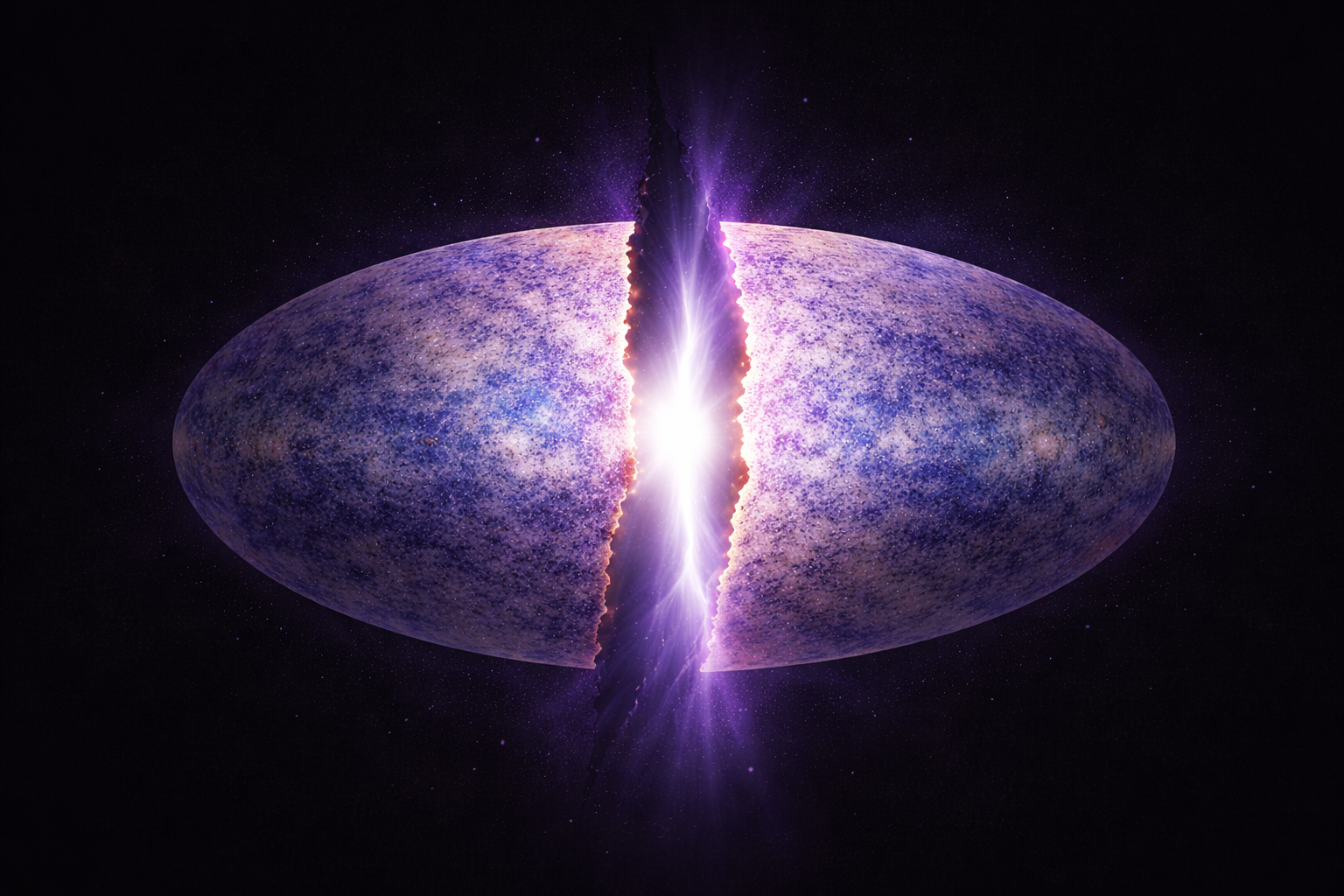
In 1948, a Cambridge physicist named Fred Hoyle confronted an idea he found unacceptable.
The universe, according to emerging evidence, appeared to have a beginning. Galaxies were flying apart. If you ran the expansion backward, everything converged—matter compressing, time rewinding to a single point.
A moment when everything began.
To Hoyle, this was intolerable.
A beginning implied a Beginner. A moment of creation implied a Creator. And Hoyle—a self-declared atheist—wanted nothing to do with that.
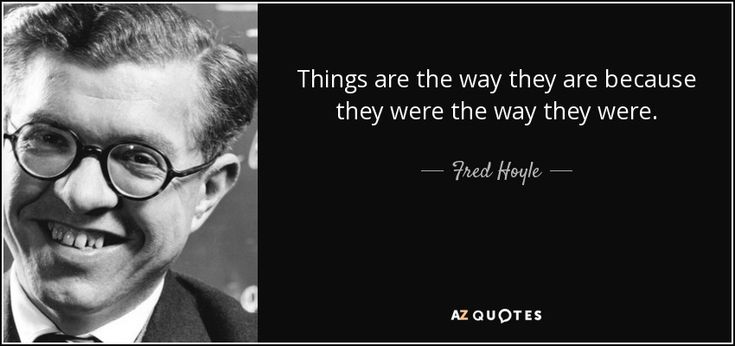
“Religion,” he said in 1951, “is but a desperate attempt to find an escape from the truly dreadful situation in which we find ourselves.”
He dismissed the emerging cosmology as “irrational” and “outside science.” What he meant, more precisely, was that it resembled the creation narrative. In a BBC interview, he put it bluntly: “The reason why scientists like the ‘Big Bang’ is because they are overshadowed by the Book of Genesis.”
So Hoyle, along with colleagues Hermann Bondi and Thomas Gold, set out to build a cosmology that would make a Creator unnecessary.
He even coined the term “Big Bang” during a 1949 radio broadcast—a vivid label to contrast with his own theory. Whether he intended mockery is debated; his opposition to the concept is not.
The Escape
Hoyle’s solution was elegant: continuous creation.
What if new matter constantly appeared throughout space? Not much—just enough to fill the gaps left by expansion. The universe would maintain constant density forever. No beginning. No end. No Creator required.
He worked out the mathematics rigorously. The physics was self-consistent. For nearly two decades, his “Steady State” theory competed seriously with the Big Bang model.
Then, in 1965, two radio astronomers in New Jersey picked up a signal they couldn’t explain.
A faint hum. Coming from every direction. A cosmic background glow that filled all of space.
It was the afterglow of the Big Bang. The echo of that intolerable beginning.
Stephen Hawking called it “the final nail in the coffin of the steady-state theory.
The evidence was decisive. Our universe did have a moment of creation. Hoyle’s theory failed.
He spent the rest of his life refusing to accept it. He died in 2001, still rejecting the Big Bang, still proposing modifications to his steady-state model.
But his mathematics lived on—describing something he never intended.
What He Found Without Knowing
Here’s what haunts me about Hoyle’s story.
He was right that continuous creation is possible. His mathematics works. The physics is coherent. A universe sustained by ongoing creation—where new matter and energy constantly appear, where things don’t run down, where decay is perpetually offset by fresh input—is not a fantasy. It’s a valid physical model.
It just doesn’t describe our universe.
Our universe was created once. Since then, nothing new has been added. We’re a closed system running on initial conditions, and closed systems have a rule: entropy always increases. Order dissolves into disorder. Bodies age. Stars burn out.
This is the physics of mortality. Everything you love is temporary because nothing is being replenished. The creation event happened 13.8 billion years ago, and we’ve been coasting on that initial input ever since.
But Hoyle’s mathematics—the continuous creation he invented to escape God—describes a different kind of realm perfectly.
A realm where rivers never stagnate.
Where milk never sours.
Where bodies never age.
Where provision never ends.
The Description That Matched
Hoyle never asked the obvious question: If his mathematics works, what does it describe?
I’ve spent years asking exactly that. What would the physics of the afterlife look like?
If Paradise exists as a real place—not just a spiritual state but an actual realm with rivers and bodies and provision—what physical laws would govern it? What would distinguish it from our universe?
The answer was in the Quran all along:
مَّثَلُ ٱلْجَنَّةِ ٱلَّتِى وُعِدَ ٱلْمُتَّقُونَ ۖ فِيهَا أَنْهَـٰرٌ مِّن مَّآءٍ غَيْرِ ءَاسِنٍ وَأَنْهَـٰرٌ مِّن لَّبَنٍ لَّمْ يَتَغَيَّرْ طَعْمُهُۥ
“The example of Paradise, which the righteous have been promised: therein are rivers of water unaltered, and rivers of milk the taste of which never changes.” — Surah Muhammad (47:15)
Unaltered. Never changes.
In our universe, this is impossible. Water stagnates. Milk sours. Entropy wins. The Second Law of Thermodynamics doesn’t make exceptions.
Unless you have continuous creation.
Unless a new order is constantly being injected into the system. Unless the decay is perpetually offset by fresh input. Unless the realm is sustained by an ongoing creative act rather than running on a one-time deposit.
عَطَآءً غَيْرَ مَجْذُوذٍ
“A gift uninterrupted.” — Surah Hud (11:108)
Uninterrupted. The sustenance never stops. The input is eternal.
لَا يَمَسُّهُمْ فِيهَا نَصَبٌ
“No fatigue will touch them therein.” — Surah Al-Hijr (15:48)
Fatigue is entropy in the body—accumulated damage, depleted resources, disorder outpacing repair. No fatigue means continuous restoration. The system never runs down because it’s being sustained.
Hoyle’s mathematics describes exactly this.
He just didn’t know Whose mathematics he had discovered.
The Distinction Hoyle Missed
But here’s what Hoyle got wrong—and what matters theologically.
Hoyle believed his mathematics proved the universe had no beginning. He thought continuous creation implied an eternal past. If matter is always being created, he reasoned, you can extrapolate backward forever.
This was his philosophical error, not a mathematical one.
Paradise was created by Allah. It has a beginning. But once created, He sustains it, and that sustenance never stops.
Hoyle’s math doesn’t describe an eternal past. It describes an eternal future.
Not the absence of a Creator—but the presence of One who never stops creating.
The Name He Didn’t Know
Hoyle’s mathematics required ongoing input—new matter appearing constantly to sustain the system. But he couldn’t explain where that input came from. He invented abstract fields with negative energy, mathematical constructs to balance the books without admitting a source.
He didn’t need the constructs.
He needed God.
Paradise is not our universe with better scenery. It’s a fundamentally different physical regime—one sustained by continuous divine creation. The rivers don’t change because they’re being perpetually renewed. The bodies don’t age because they’re being perpetually restored.
Hoyle’s equations work perfectly.
They just require admitting what he couldn’t: there is a Creator, and He sustains what He creates.
The Irony
Let me state it plainly.
Fred Hoyle, driven by philosophical revulsion at the idea of God, invented a mathematical framework specifically designed to make a Creator unnecessary.
That framework failed to describe our universe—because our universe was designed to perish.
But it describes Paradise exactly—a realm designed to endure.
The man running from God accidentally wrote the physics of divine sustenance.
I don’t know what Hoyle would say if he knew. He died still rejecting the origin for creation, still insisting the universe needed no Creator.
But his equations remain—not as a description of this cosmos, but as a window into another.
The realm where nothing decays.
What This Means for You
You live in a universe that was created once and is running down.
A realm that runs down forces urgency. You cannot drift forever. The clock is ticking. Entropy is accumulating in your body right now. The test has a deadline.
Right now, you’re making a choice. Maybe it’s whether to pray or postpone. Maybe it’s whether to forgive or hold the grudge. Maybe it’s whether to submit or resist.
That choice matters—not only because God is watching to judge, but also because you are encoding information into reality. The universe keeps perfect records.
And your choices are not lost.
Physics has a principle: information is never destroyed. Every action, every decision, every orientation of your will encodes something into the fabric of reality.
فَمَن يَعْمَلْ مِثْقَالَ ذَرَّةٍ خَيْرًا يَرَهُۥ ۚ وَمَن يَعْمَلْ مِثْقَالَ ذَرَّةٍ شَرًّا يَرَهُۥ
“Whoever does an atom’s weight of good will see it. And whoever does an atom’s weight of evil will see it.” — Surah Az-Zalzalah (99:7-8)
An atom’s weight. Nothing is lost.
The realm you enter after this one depends on what you encoded here. Those who aligned with the Creator—who submitted to His order, who oriented their will toward what He commanded—enter a realm sustained by His continuous creation. Rivers that never change. Bodies that never tire. Provision that never ends.
Did we figure out the physics of Paradise?
The unseen remains unseen. But we may have glimpsed the mathematical signature of divine sustenance.
The Quran describes Paradise with precision: rivers that never change their taste, provision that is never interrupted, and bodies that never tire. These aren’t poetic flourishes—they’re descriptions of a realm where decay doesn’t win.
An atheist discovered this mathematics while running from God.
He just didn’t know what he’d found.
All Quranic translations are carefully adapted for clarity while maintaining fidelity to the Arabic text. Readers are encouraged to refer to the original Arabic for deeper study.
Peace, Amer Sakr, Ph.D.
Stay with the work
A short letter, when there is something worth sending.
No schedule. No marketing. A note when a new piece is published, sometimes a passage being worked through, occasionally nothing for weeks. Roughly once a month.