Spirituality · / /
Portal 4: Ibrahim - The Surrender That Sets You Free
#14- How Unified Intention Ends the War You’re Fighting With Reality

Peace,
You’re carrying something you were never meant to carry.
You’re carrying the weight of outcomes.
The weight of lying awake, wondering if you said the right thing in that conversation three days ago. The weight of checking your phone every five minutes to see if the result arrived. The weight of mentally rehearsing every possible disaster that might happen tomorrow.
The weight of pretending that if you worry hard enough, plan carefully enough, control tightly enough, you can somehow force reality to bend to your will.
This weight is crushing you.
And it was never yours to carry.
What Surrender Is Not
Before we go further, let me tell you what this article is not about.
This is not about becoming passive. Not about giving up. Not about sitting back and saying “whatever happens, happens” while doing nothing.
That’s fatalism dressed in spiritual language. That’s the corruption of surrender that makes strong people weak.
Real surrender—the kind Ibrahim ﷺ mastered, the kind that transforms anxiety into peace—is something else entirely.
It’s the moment you release outcomes while acting with full responsibility. It’s doing everything in your power, then trusting God with what happens next.
And when that moment comes, everything shifts.
The Pattern: What Happened With the Wallet
Let me show you what this looks like in real life.
A couple of weeks ago, I lost my wallet.
Not just any wallet—the one my wife gave me as a gift. Inside it: my passport, my ID, my US driver’s license, and important documents collected from different countries. Years of accumulated identity, all in one leather fold.
Gone.
How did I lose it? When was the last time I had it? What if I never get it back? How will I replace everything? What will I tell my wife?
The questions changed nothing. The worry solved nothing. But I kept gripping anyway, as if the tightness itself would somehow undo what had already happened.
Then a realization cut through the noise:
There was nothing I could have done to prevent this wallet from being lost. God had already written it before it happened.
And there is nothing I can do now that will guarantee I’ll get my wallet back. Only God can bring it back to me.
Two truths. Past and future. Both are completely outside my control.
So I surrendered the outcomes.
And the moment I did, immediate relief.
The racing mind went quiet. Not because the situation changed—the wallet was still lost. But because I stopped trying to carry what was never mine to carry.
Then I acted.
I reported the loss at two police stations. I blocked my bank card and issued a new one. I started the process of replacing all my official documents. I did everything practical, everything within my power.
But I did it from a different place.
When I went to the police station, I didn’t go thinking, “Maybe this will help me get it back.” I went thinking, “This is my responsibility to do, regardless of outcome.” See the difference? Same action. Different internal state. One is attached. One is surrendered.
I still haven’t found my wallet. The documents are still being replaced. The gift from my wife is still gone.
But I’m at peace with losing it.
Because I did my part, and the rest is with God. And I trust that the ultimate outcome—whatever it is—is mercy.
This is Portal 4
The Five Stages You Just Witnessed
Let me break down what just happened:
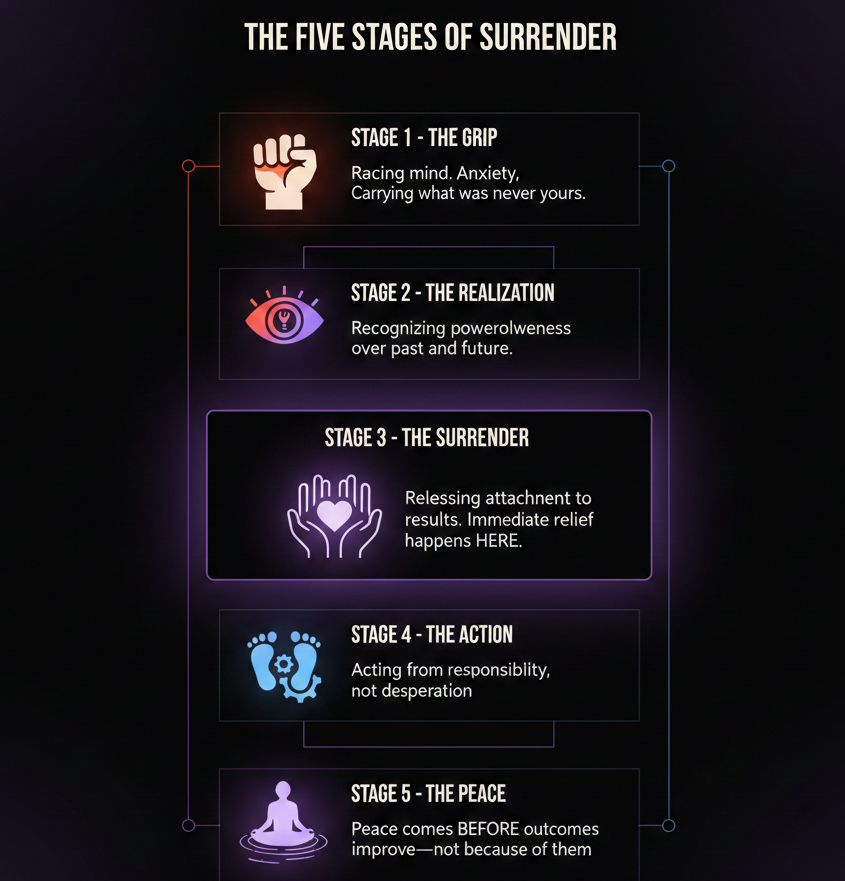
This is the pattern Ibrahim ﷺ walked. This is the pattern you must learn.
The Deeper Test: When the Stakes Are Higher
The wallet was a small test. A training exercise. God is sending you something manageable to build the muscle.
But what happens when the stakes are higher?
When my mother was hospitalized, I did everything I could. I worked with doctors. I stayed present with her. I tried every avenue available to help her recover.
But at some point, I knew it was out of my hands.
When she passed away, I didn’t spiral into “what if we had gone to a different doctor” or “if only we had done this instead.” I had already done everything within my power. I had already surrendered the outcome.
And because I had surrendered, I could absorb the shock.
I could remain steady. I could help my family process the loss. I could support her friends and relatives through their grief.
Surrendering doesn’t make you weak.
It makes you strong enough to carry what actually belongs to you—without collapsing under the weight of what doesn’t.
Ibrahim’s Three Tests: The Pattern Made Clear
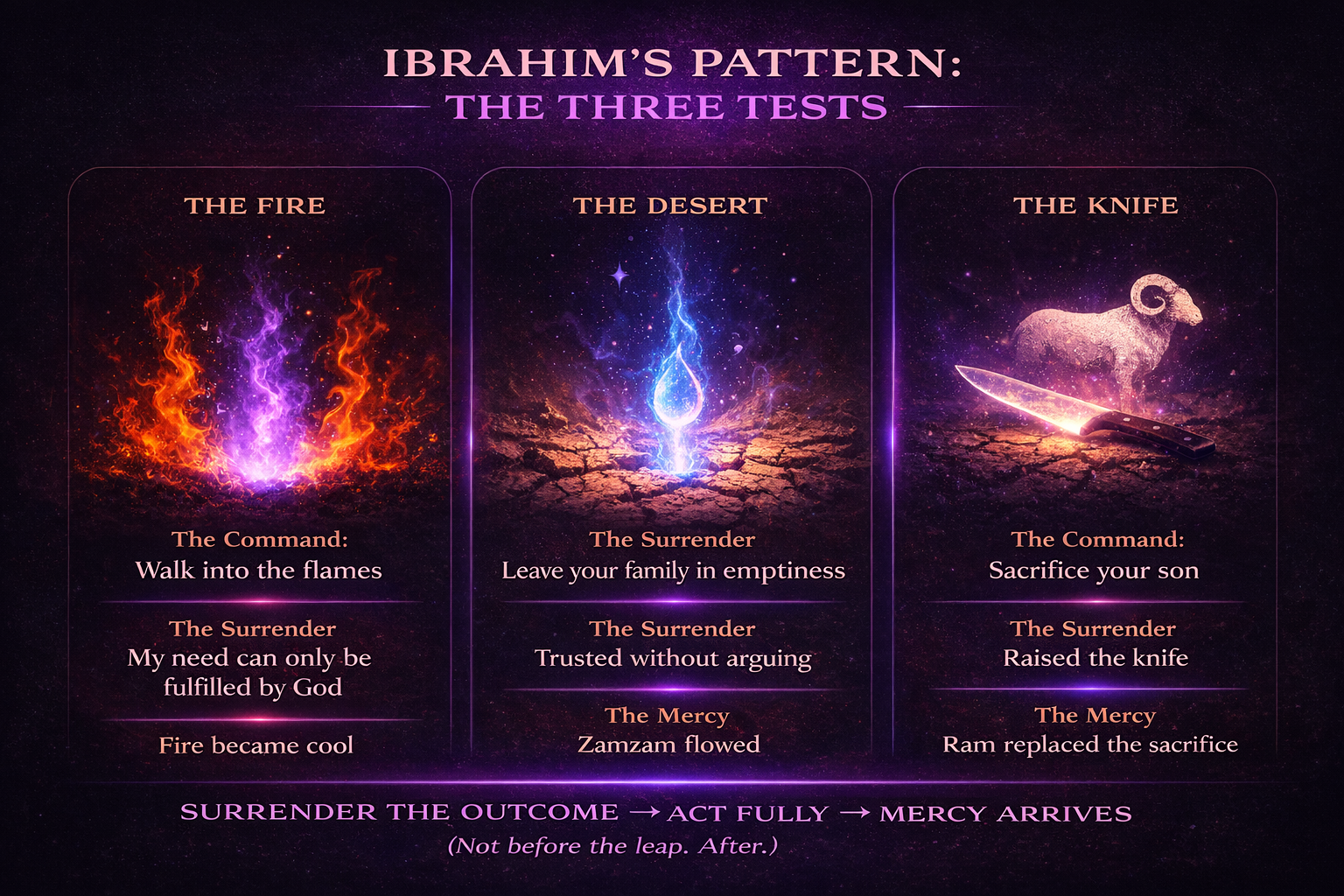
Ibrahim ﷺ walked this pattern three times, each deeper than the last.
The Fire
When his people threw him into the flames, the angel Jibreel came to him before he entered. “Do you need anything from me?” Any help. Any intervention. Any rescue.
Ibrahim’s answer revealed everything: “My need can only be fulfilled by God.”
Not “I don’t need help.” But “Help from anyone but God is not help at all.”
He was thrown into fire. And God made the fire cool—after he entered, not before.
Hajar and Ismail in the Desert
God commanded him to leave his wife and infant son in an empty desert. No water. No food. No shelter. Just sand and sky and trust.
Ibrahim ﷺ didn’t argue. Didn’t negotiate. Didn’t demand to understand why. He surrendered the outcome—their survival, their suffering, their future—to the One who commanded him.
And God sent Zamzam. From barren earth, water flowed.
The Knife Over His Son
Years later, God commanded him to sacrifice the son he had waited so long to have. The son promised. The son loved.
Ibrahim ﷺ raised the knife.
And God replaced the sacrifice with mercy.
Every single time—every test, every fire, every impossible command—the pattern held:
Surrender the outcome → Act fully → Mercy arrives.
Not before the leap. After.
The Quranic Law of Surrender
Allah doesn’t just command surrender. He explains why it works:
مَآ أَصَابَ مِن مُّصِيبَةٍۢ فِى ٱلْأَرْضِ وَلَا فِىٓ أَنفُسِكُمْ إِلَّا فِى كِتَـٰبٍۢ مِّن قَبْلِ أَن نَّبْرَأَهَآ ۚ إِنَّ ذَٰلِكَ عَلَى ٱللَّهِ يَسِيرٌۭ
“No disaster strikes upon the earth or among yourselves except that it is in a register before We bring it into being—indeed that, for Allah, is easy.” — Surah Al-Hadid (57:22)
Everything that happens was already written. Before the universe began. Before you were born. Before the disaster arrived.
But here’s what most people miss—Allah didn’t reveal this verse just to inform you about predestination. He revealed it to regulate your emotions:
لِّكَيْلَا تَأْسَوْا۟ عَلَىٰ مَا فَاتَكُمْ وَلَا تَفْرَحُوا۟ بِمَآ ءَاتَىٰكُمْ ۗ وَٱللَّهُ لَا يُحِبُّ كُلَّ مُخْتَالٍۢ فَخُورٍ
“In order that you not despair over what has eluded you and not exult in pride over what He has given you. And Allah does not like everyone self-deluded and boastful.” — Surah Al-Hadid (57:23)
Read that again. Slowly.
“In order that you not despair...”
The law of surrender is a law designed to affect your emotional state. When you truly grasp that everything was already written, despair becomes impossible. Anxiety becomes irrational. Grief transforms into acceptance.
You stop despairing over what you lost because you understand: it was never going to stay.
You stop being arrogant about what you gained because you understand: it was never your doing.
Surrender is not just theology. It’s emotional regulation. It’s the difference between carrying the weight and releasing it.
How to Actually Surrender (The Mechanism)
So how do you move from grip to release?
This is the question everyone asks. And the answer is simpler than you think—and harder than you want.
Step 1: The Mind Conversation
You need to have a conversation with yourself. Out loud or in silence. But it must be honest.
Ask yourself:
Even if I worry until infinity, will that change anything?
Can my anxiety alter what was already written?
Can my planning control outcomes that belong to God alone?
The answer is always no.
So why grip? Why carry? Why exhaust yourself pretending you have power you don’t possess?
Surrender is recognizing your powerlessness—and finding relief in it.
Step 2: The Affirmation
The Prophet ﷺ gave us words to anchor this truth in our souls. When you feel the grip tightening, when anxiety rises, when you’re tempted to carry outcomes again—say this:
لَا حَوْلَ وَلَا قُوَّةَ إِلَّا بِاللَّهِ
“There is no power and no strength except through Allah.”
These are not magic words. They are programming. They rewire the Soul’s default response from “I must control this” to “Only Allah controls this.”
Say it until you believe it. Say it until the Soul stops resisting. Say it until the grip releases.
Step 3: The Instantaneous Decision
Surrender is not gradual. It’s a decision you make and apply instantly.
You’re either gripping or releasing. You’re either carrying outcomes or trusting God with them. There’s no middle ground.
The moment you decide—the moment you truly let go—immediate relief.
But here’s what takes time: training the muscle. Building the reflex. Learning to surrender quickly instead of gripping for days before you finally release.
This is the work of Portal 4. Not learning to surrender once, but learning to surrender immediately every time the grip tries to return.
Step 4: The Paradox of Action
Surrender means releasing attachment to outcomes while acting fully from a sense of responsibility.
When you pay money to replace the lost documents, you do it with conviction. When you spend hours at government offices, you own the situation without feeling blame. When you explain the loss to your wife, your inner state of peace doesn’t change.
Because you’re in terms with the fact that nothing will ever change the outcome except Allah.
You do your part. God does His.
The Truth About Loss
Here’s what you need to understand about that wallet, about that loss, about everything you think you own:
إِنَّا لِلَّهِ وَإِنَّا إِلَيْهِ رَاجِعُونَ
“To Allah we belong, and to Him we return.”
We never actually lose anything. Everything was always His. He gave it for a moment. He took it back. Nothing that passes through your hands was ever yours to keep.
The wallet was mine for a while. God gave it. God took it. So what?
It’s just a material thing. Something that would sooner or later stop being mine anyway—through loss, or damage, or death.
What we perceive as ours isn’t really ours. We’re stewards, not owners. Temporary holders, not permanent possessors.
When you grasp this—truly grasp it—loss becomes impossible because you can’t lose what was never yours.
The Strength That Comes From Surrender
The modern mind sees surrender as weakness.
It’s the opposite.
Surrender makes you stronger in the moment and more in control over your life.
When my mother died, I didn’t collapse. I absorbed the shock. I helped my family, my relatives, her friends process the tragedy because I wasn’t drowning in my own resistance.
When you surrender, you stop wasting energy fighting reality. You stop exhausting yourself trying to control what you cannot control. You conserve your strength for what actually belongs to you—your response, your action, your responsibility.
This is what we learn from Ibrahim ﷺ.
He walked into fire with more strength than the men who threw him in.
The Training Regimen
Portal 4 is not a destination you arrive at once. It’s a muscle you build.
Today: Notice when you’re gripping. Just notice. Don’t try to fix it yet. Just become aware of the tightness, the worry, the mental rehearsal of disasters.
Tomorrow:
- When you notice the grip, ask the question: Will worrying about this change the outcome? Let the answer settle.
- Practice the affirmation. Every time anxiety rises: لَا حَوْلَ وَلَا قُوَّةَ إِلَّا بِاللَّهِ. Feel the words. Let them rewire you.
After tomorrow:
Make the decision. Pick one thing you’re gripping right now—one outcome you’re trying to control. Surrender it. Out loud. “I release this outcome to God. I will do my part. The result belongs to Him.”
After after tomorrow:
Build the reflex. How quickly can you move from grip to release? Can you surrender in hours instead of days? In minutes instead of hours?
Moving forward:
Test yourself with bigger things. Health. Relationships. Career. Money. Can you surrender what terrifies you?
You’ll know you’ve mastered Portal 4 when surrender becomes your default response instead of your exception—when the grip no longer takes days to release but happens almost instantly, the moment you notice it.
This is the work. This is how you master Portal 4.
Not by surrendering once in a moment of clarity—but by building the muscle so strong that surrender becomes your default, not your exception.
The Pivot
Here’s why Portal 4 matters more than any portal before it.
Portals 1-3 were SELF-CENTERED:
You learned to accept your human design (Adam). You learned to act on knowledge (Idrees). You learned to express truth despite opposition (Noah).
All necessary. All foundational. But all focused on developing YOU—your spiritual maturity, your consciousness, your ability to stand.
Portal 4 is GOD-CENTERED:
Everything shifts here. This is where your entire life orients around a single magnetic field: pleasing God in everything.
Not just in prayer. Not just in “religious” acts. In everything. Your work. Your relationships. Your money. Your rest. Your ambitions. Your losses.
Every micro-action aligns under one unified intention: serving Him.
When you master Portal 4, the friction between Soul and Spirit ends. They stop fighting each other. They move in harmony. And that harmony is what prepares you for Portals 5-7—where you finally turn outward to serve, liberate, and lead others.
But you cannot lead others from a God-centered place if you haven’t surrendered to God yourself.
Portal 4 is the pivot. The center. The non-negotiable foundation for everything that comes after.
The Command
So here’s what I’m asking you to do.
Now.
Name the thing you’re gripping right now. The outcome you’re trying to control. The weight you’re carrying that was never yours.
Say it out loud:
“I surrender this outcome to God. I will do my part. The result belongs to Him.”
Then act. Do everything practical. Everything responsible. Everything within your power.
But let go of the attachment to how it turns out.
Stop lying awake rehearsing disasters. Stop checking your phone every five minutes for the result. Stop pretending your worry will change what's already been written.
Trust that the ultimate outcome—whatever it is—is mercy, even if you can’t see how, even if it takes years to understand. Even if you never understand at all.
Surrender is not weakness.
It’s the strength to carry what belongs to you—without collapsing under the weight of what doesn’t.
Ibrahim ﷺ walked into fire and came out unburned.
The miracle comes after the surrender, not before.
You’re standing at the edge of your own fire right now. The grip is real. The fear is real. The weight is crushing.
Release it.
Surrender.
And walk.
All Quranic translations are carefully adapted for clarity while maintaining fidelity to the Arabic text. Readers are encouraged to refer to the original Arabic for deeper study.
Peace,
Amer Sakr, Ph.D.
Stay with the work
A short letter, when there is something worth sending.
No schedule. No marketing. A note when a new piece is published, sometimes a passage being worked through, occasionally nothing for weeks. Roughly once a month.