Spirituality · / /
Taqwa: The Consciousness That Sets You Free
#13 - Why fearing Allah means you stop fearing everyone else
You’re exhausted.
Not from working too hard. Not from sleeping too little. You’re exhausted from performing. From the endless calculation of how you’ll be perceived. From the weight of invisible audiences judging every move you make.
You feel watched constantly—by your employer who tracks your productivity, by followers who expect consistency, by family members with their silent expectations, by algorithms that reward certain versions of you and punish others.
You’ve become a performer in a play that never ends. And somewhere along the way, you forgot who you actually are when no one is looking.
The Replacement
The modern world promises liberation. Freedom from judgment. Freedom from religious guilt. Freedom from the “oppressive” idea that an unseen God monitors your every move.
But look at what you got instead.
You traded one Observer for thousands. You traded the consciousness of Allah for the consciousness of everyone else. And those everyone-elses are demanding, fickle, impossible to please.
You can never perform well enough, consistently enough, to secure their permanent approval. So you keep performing. Keep adjusting. Keep exhausting yourself for audiences that will never be satisfied.
This is not freedom. This is slavery with better marketing.
Allah’s criteria are clear. They don’t change based on trends. They don’t shift when the cultural winds blow differently. You can know, with certainty, what pleases Him and what invites His anger.
The Dajjal’s first move was to make you forget the Unseen—to convince you that only the material world is real, that only measurable things matter, that metaphysics is superstition. And once you stopped believing in the unseen, you became enslaved to what you could see: other people’s faces, other people’s opinions, other people’s approval.
You stopped fearing Allah because you forgot He was watching.
And you started fearing everyone else because they very clearly are.
The Second Corruption
But the Dajjal wasn’t finished.
For those who still believed—for Muslims who maintained some connection to their faith—a subtler corruption was needed. One that would neutralize Taqwa without appearing to attack Islam directly.
So he changed the nature of the relationship.
He gave you a god who only loves. A god whose primary function is to make you feel good about yourself. A deity unconditionally accepting, so that discipline becomes unnecessary, accountability becomes harsh, and fear becomes a relic of primitive religion.
This is the god of modern spiritual bypassing. The god who asks nothing and forgives everything. The god who exists to affirm you, not to transform you.
But this is not the God of the Quran.
The Quran is explicit about the nature of the relationship. It balances. It holds in tension what the modern mind wants to collapse into simplicity.
يَدْعُونَ رَبَّهُمْ خَوْفًا وَطَمَعًا
“They call upon their Lord in fear and hope.” — Surah As-Sajdah (32:16)
Fear and hope. Not one or the other. Not hope alone because fear feels uncomfortable. Not fear alone because hope feels naive. Both. Held together. In every act of worship.
The love-only approach removes half of the equation. And when you remove fear, you remove Taqwa. And when you remove Taqwa, you remove the very thing that disciplines the Soul.
Without fear, the Soul has no reason to restrain itself. It can pursue whatever it wants and still expect love. It can ignore divine limits and still feel spiritually comfortable. It can perform for every audience but not to Allah, and assume He’ll approve anyway.
This is not a relationship. This is entitlement dressed in religious language.
What Taqwa Actually Is
Taqwa (تقوى) comes from the root وقى—to protect, to guard, to shield.
It means protecting yourself from the wrath of Allah.
His wrath is real, consequences are real, and the Soul that forgets this truth will destroy itself through undisciplined desire.
Taqwa is the active, conscious practice of avoiding what invites God’s anger. It is walking through life aware that you are being observed by the One whose observation actually matters—and adjusting your behavior accordingly.
When you are in a state of Taqwa, something shifts. You feel watched, especially in solitude. Especially when no human eye could possibly see what you’re about to do. The private moment becomes the test, because that’s where your true audience is revealed.
Who are you performing for when no one is looking?
If the answer is “no one”—if you behave differently in private than in public—then you were never conscious of Allah. You were only ever conscious of people.
Taqwa corrects this. It makes the unseen Observer more real than every visible one. And paradoxically, this is what sets you free.
When you’re conscious of Allah, you stop being controlled by everyone else. Their approval loses its grip. Their criticism loses its sting. You have one Observer. And because His criteria don’t change, because His observation is constant, because His approval is actually attainable through obedience, you can finally stop the exhausting performance.
Taqwa doesn’t add another observer to your already-crowded stage.
It replaces all of them with the only One whose observation actually matters.
The Condition You Weren’t Told About
Here is what the love-only theology hides from you:
Allah’s love is conditional.
Not His mercy—His mercy encompasses all things. But His love, His mahabbah, the intimate divine affection that the Soul longs for—this comes with a condition.
قُلْ إِن كُنتُمْ تُحِبُّونَ اللَّهَ فَاتَّبِعُونِي يُحْبِبْكُمُ اللَّهُ
“Say: If you truly love Allah, then follow me, and Allah will love you.” — Surah Aal-Imran (3:31)
If you love Allah—then follow. And then—only then—Allah will love you back.
The sequence matters. Your love is not enough. Your feelings of spiritual warmth are not enough. Your sense of connection during a beautiful sunset is not enough.
Following is required. Obedience is required. Taqwa—the disciplined consciousness that keeps you within divine limits—is required.
The modern approach reverses this. It says: Allah already loves you unconditionally, so just feel connected. No discipline needed. No fear necessary. Just love.
But this produces a Soul that never transforms. A Soul that feels spiritual while remaining unchanged. A Soul that mistakes emotional comfort for actual closeness to Allah.
The Quran defines success differently:
قَدْ أَفْلَحَ الْمُؤْمِنُونَ الَّذِينَ هُمْ فِي صَلَاتِهِمْ خَاشِعُونَ
“Successful indeed are the believers—those who are humble and reverent in their prayer.” — Surah Al-Mu’minun (23:1-2)
Reverent humility, the inner posture of awe and submission before Allah. This is the metric. Not feeling loved. Not feeling comfortable. But standing before Allah with the fear that disciplines and the hope that sustains.
Success is contingent on this.
Taqwa is how you get there.
The Prerequisite for Seeing Clearly
There is something Taqwa gives you that nothing else can.
The Quran calls it furqan—the criterion. The ability to distinguish truth from falsehood, what matters from what distracts, what saves from what destroys.
يَا أَيُّهَا الَّذِينَ آمَنُوا إِن تَتَّقُوا اللَّهَ يَجْعَل لَّكُمْ فُرْقَانًا
“O you who believe, if you have taqwa of Allah, He will grant you a furqan.” — Surah Al-Anfal (8:29)
This is why you can’t see clearly anymore.
Not because you lack information. Not because you lack intelligence. Not because you lack access.
You lack Taqwa.
And without Taqwa, there is no furqan. Without the consciousness of Allah that disciplines the Soul, the criterion for distinguishing truth simply doesn’t activate. You remain confused, overwhelmed, unable to discern which voice to follow among the thousands competing for your attention.
The Spirit within you already knows what’s true. It recognized the truth the first time you encountered it. But the Soul—undisciplined, unfearing, performing for every audience but not for Allah—cannot hear what the Spirit is saying.
Taqwa is the Soul finally listening.
It is the Soul remembering that it is being watched by the One whose watching brings clarity, not anxiety. And in that remembrance, the noise quiets. The competing voices fade. The Furqan emerges.
You start to see.
Training the Soul to Remember
The brain learns through repetition and association. What you practice becomes automatic, what you neglect atrophies. Taqwa is not a feeling you wait for—it is a neural pathway you build.
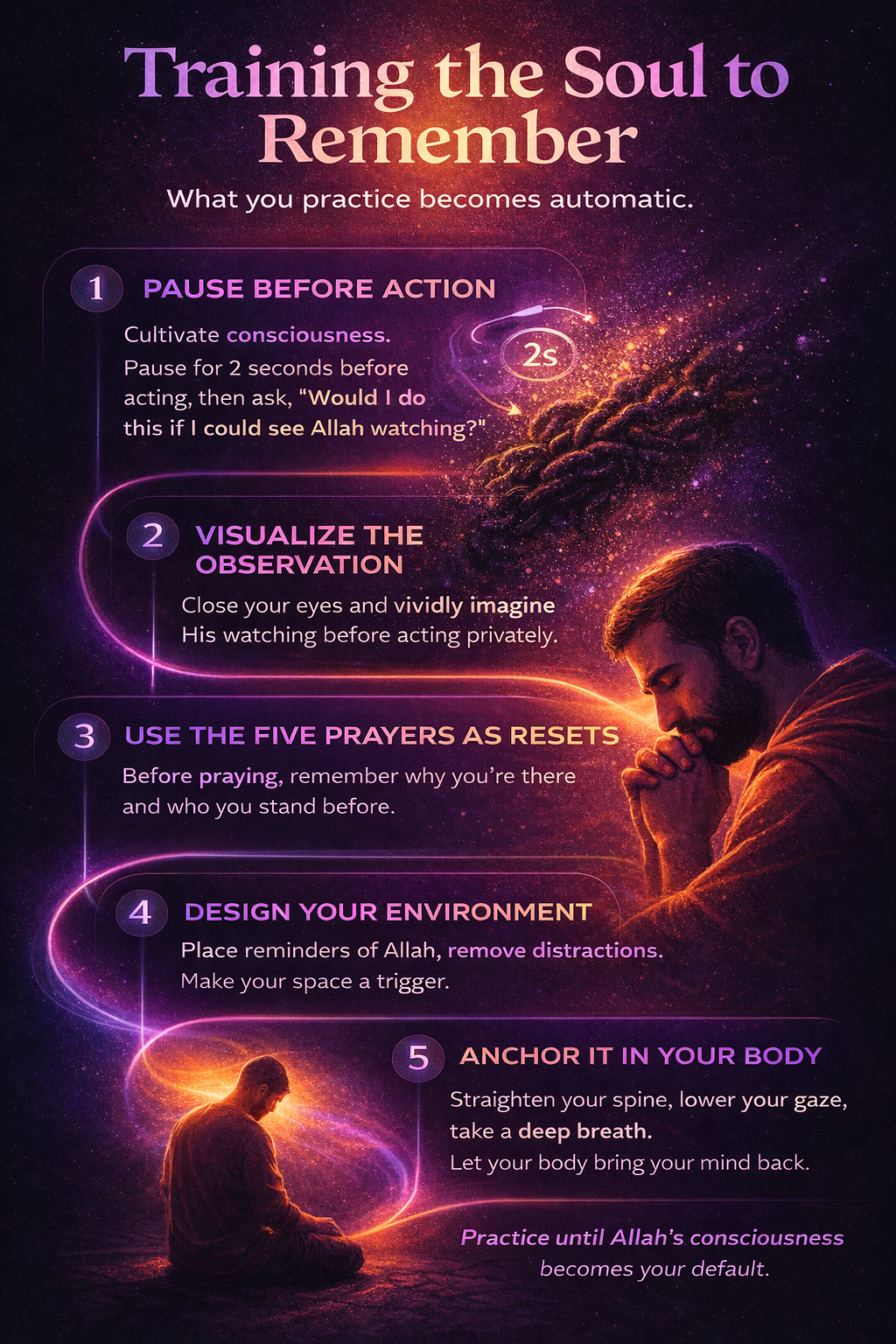
Here is how you build it.
Pause before action to cultivate consciousness. Create a two-second gap before acting, then ask, "Would I do this if I could see Allah watching?" This pause interrupts autopilot, bringing awareness and shifting the Soul from heedlessness. With practice, the question becomes automatic.
Feel the observation. Your brain can't fully distinguish between vivid imagination and real experience. Before acting privately—like opening a browser, speaking, or taking shortcuts—close your eyes for three seconds and feel yourself being watched by Allah. This activates the same neural pathways as actual observation. You'll feel watched because you're mentally practicing being watched.
Use the five prayers as resets, spaced throughout the day to interrupt heedlessness and reconnect consciously with Allah. Before praying, take ten seconds to remember why you’re there and who you’re standing before. This transforms prayers into daily Taqwa training rather than mere rituals.
Design your environment to influence your consciousness. Place reminders of Allah in your workspace as triggers, not decorations. Remove distractions like phones and screens that lead to heedlessness. No one can resist poorly designed environments indefinitely; design yours to remind you before your willpower is tested.
Anchor it in your body. Consciousness isn’t just mental—it resides in posture, breath, and stillness. When you drift toward heedlessness, change your body: straighten your spine, lower your gaze, take a deep breath. Physical shifts trigger mental shifts. Your body can swiftly bring your awareness back faster than your thoughts.
These are not spiritual suggestions but how the brain learns. Practice until Allah's consciousness becomes your default—feeling watched by Him before others.
The Only Audience That Sets You Free
You’ve been performing for audiences that will never be satisfied, exhausting yourself for observers who won’t give you rest.
You’ve been adjusting and optimizing for approval that shifts like sand, forgetting the Observer whose approval is attainable and whose criteria are clear.
When you become truly conscious of Allah—changing behavior when no one is watching—you stop being enslaved by others' opinions.
Their approval no longer defines your worth.
You have one Listener, One Observer, One Judge.
Fear Him correctly, and you stop fearing others.
This is freedom, clarity, and Taqwa.
The Quran opens with praise for those who possess it:
ذَٰلِكَ الْكِتَابُ لَا رَيْبَ ۛ فِيهِ ۛ هُدًى لِّلْمُتَّقِينَ
“This is the Book in which there is no doubt, a guidance for the Muttaqeen.” — Surah Al-Baqarah (2:2)
The guidance is there. It has always been there. But it only benefits those who approach it with Taqwa—with the consciousness of Allah that disciplines the Soul and opens the heart to receive.
Without Taqwa, you can read the Quran and remain unchanged.
With Taqwa, it becomes the guidance it was always meant to be.
Will you remember the One who already sees?
The One whose fear disciplines.
The One whose hope sustains.
The One whose love is conditional—and therefore actually worth earning.
All Quranic translations are carefully adapted for clarity while maintaining fidelity to the Arabic text. Readers are encouraged to refer to the original Arabic for deeper study.
Peace, Amer Sakr, Ph.D.
Stay with the work
A short letter, when there is something worth sending.
No schedule. No marketing. A note when a new piece is published, sometimes a passage being worked through, occasionally nothing for weeks. Roughly once a month.