Yasin · / /
Surah Yasin (3): Everything Has a Counterpart — Except Him
#21 — Ayat 33–44: The three signs you were never meant to take for granted
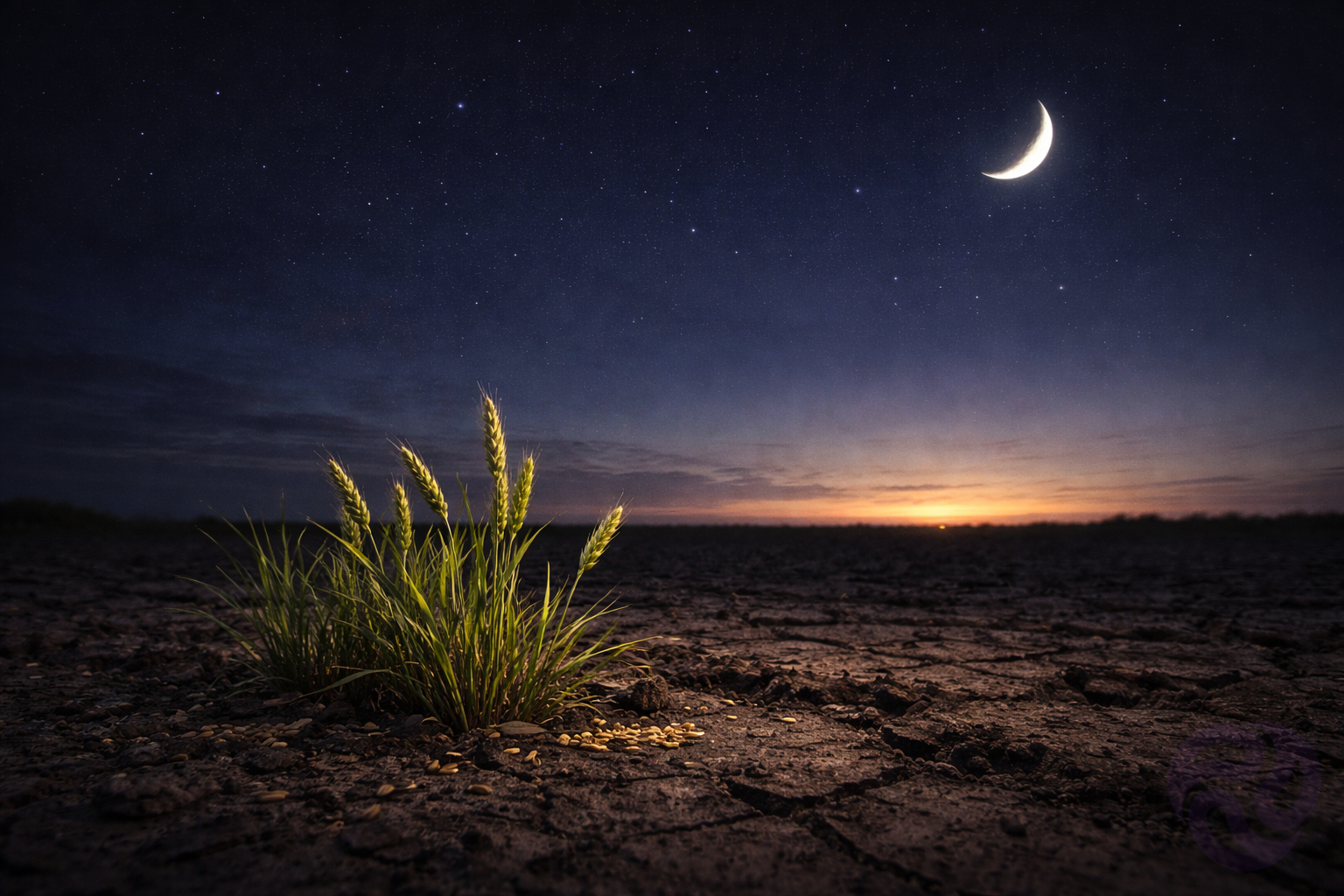
Everything around you exists in pairs. Male and female. Night and day. Earth and sky. The grain that feeds you and the soil that was dead before it grew.
The Quran says Allah created all the pairs — from what the earth produces, from yourselves, and from what you do not yet know. Buried inside that statement is the most elegant proof of God’s Oneness ever articulated: if everything in creation has a counterpart, the Creator Himself does not. The pairs do not exist for beauty. They exist as evidence. And the moment you receive them as evidence — not as background noise nor as entitlement, but as testimony — you have begun to fear al-Rahmān in the unseen. The one quality, from Part 1, that separates the living from the spiritually dead.
In Part 2, the Quran brought the definition of a spiritually alive man to life: one unnamed man who heard the truth, spoke it, and entered Paradise. The metaphysical prison of part one was the diagnosis of spiritual death. The man was the demonstration of how to escape that prison.
When I continued into ayat 33 through 44, the surah changed its method. It stopped telling stories and began placing evidence before me — three signs covering every domain of human experience. Earth. Sky. Sea. The first dismantles the illusion that you fed yourself. The second dismantles the illusion that the universe runs itself. The third dismantles the illusion that humanity has kept itself alive at any point in history.
The Illusion That You Fed Yourself (Ayat 33–36)
وَآيَةٌ لَّهُمُ الْأَرْضُ الْمَيْتَةُ أَحْيَيْنَاهَا وَأَخْرَجْنَا مِنْهَا حَبًّا فَمِنْهُ يَأْكُلُونَ · وَجَعَلْنَا فِيهَا جَنَّاتٍ مِّن نَّخِيلٍ وَأَعْنَابٍ وَفَجَّرْنَا فِيهَا مِنَ الْعُيُونِ · لِيَأْكُلُوا مِن ثَمَرِهِ وَمَا عَمِلَتْهُ أَيْدِيهِمْ ۖ أَفَلَا يَشْكُرُونَ · سُبْحَانَ الَّذِي خَلَقَ الْأَزْوَاجَ كُلَّهَا مِمَّا تُنبِتُ الْأَرْضُ وَمِنْ أَنفُسِهِمْ وَمِمَّا لَا يَعْلَمُونَ
And a sign for them is the dead earth — We gave it life and brought forth from it grain, and from it they eat. And We placed therein gardens of date palms and grapevines, and We caused springs to burst forth therein. So that they may eat of its fruit and what their hands have made — will they not then be grateful? Glory be to the One who created all the pairs — from what the earth grows, and from themselves, and from what they do not know. — (36:33–36)
Remember the prison from Part 1 — heads locked, barriers on every side, a veil over the eyes. The signs that the surah is about to present are not hidden. They are the most visible things in the world. The prison was never that the evidence was absent. The prison is that the eyes are covered.
Ayah 33 uses the past tense — ahyaynaha, “We gave it life.” The claim in ayah 12 was present tense. The evidence is past tense. It already happened. It happens every season. You walk on dead soil in winter and eat from it in summer, and you have done this your entire life without once stopping to ask who made dead ground come alive.
And the surah does not stop at grain. It escalates. Grain is basic sustenance — you need it. But then come gardens of date palms and grapevines — you do not merely need these, you enjoy them. Then springs that burst forth — the verb is fajjarna, an intensive form meaning explosive emergence, not gentle seeping.¹ The provision moves from necessity to luxury to effortless abundance. Each step makes the ingratitude harder to justify.
The word for gardens here — jannat — shares its root with jannah, Paradise.² Every earthly garden carries an echo of the Garden. What God does to dead soil is a preview of what He will do to dead bones. The earth is not merely providing for you. It is rehearsing the resurrection before your eyes, season after season.
The same combination — gardens of palms and grapes with a river gushing through them — appears in Surah Al-Kahf.³
There, a man owned two such gardens and responded with arrogance: “I do not think this will ever perish.”³
His companion rebuked him: “Have you denied the One who created you?”³
The Quran presents the same abundance here in Yasin and asks a different question: afala yashkurun — will they not be grateful? (the opposite word of kufr that appears in Surat Al-Kahf) Al-Kahf showed what arrogance does with the blessing. Yasin asks: What will you do about it?
The Quran elsewhere makes the equation explicit: if you are grateful, I will increase you — and if you are ungrateful, My punishment is severe.⁴ The opposite of shukr is not rudeness. It is kufr.
Then comes a phrase worth pausing over. Allah says they eat from its fruit “and what their hands have made.” This does not erase human effort. You planted, you tended, you harvested. But the dead earth that made any of your efforts fruitful was not your doing. The rain that fell on it was not yours to command. The seed that split open in darkness was not yours to engineer.⁵ God is not denying that you worked. He is reminding you that your work was only possible because He worked first.
And then comes — “Glory be to the One who created all the pairs.”
This is the pivot of the entire section. The gaze lifts from the ground to the principle behind it. Everything the earth produces comes in pairs. Everything within you comes in pairs — and the Quran elsewhere describes the nafs itself as carrying its own pairing: its fujur and its taqwa, its capacity for wickedness and its capacity for God-consciousness.⁶ And then the ayah opens a door that no generation can close: wa mimma la ya’lamun — and from what they do not know. This covers what future science will discover and what lies entirely beyond human investigation. The testimony of pairs extends into territories you will never map.
The logic is complete. If everything in creation — known and unknown, seen and unseen, external and internal — exists in duality, then the One who created duality itself is necessarily One. He does not have a counterpart. The pairs are not only designed. They are the universe’s permanent testimony to the Oneness of its Originator.
The Illusion That the Universe Runs Itself (Ayat 37–40)
وَآيَةٌ لَّهُمُ اللَّيْلُ نَسْلَخُ مِنْهُ النَّهَارَ فَإِذَا هُمْ مُّظْلِمُونَ · وَالشَّمْسُ تَجْرِي لِمُسْتَقَرٍّ لَّهَا ۚ ذَٰلِكَ تَقْدِيرُ الْعَزِيزِ الْعَلِيمِ · وَالْقَمَرَ قَدَّرْنَاهُ مَنَازِلَ حَتَّىٰ عَادَ كَالْعُرْجُونِ الْقَدِيمِ · لَا الشَّمْسُ يَنبَغِي لَهَا أَن تُدْرِكَ الْقَمَرَ وَلَا اللَّيْلُ سَابِقُ النَّهَارِ ۚ وَكُلٌّ فِي فَلَكٍ يَسْبَحُونَ
And a sign for them is the night — We strip the daylight from it, and behold, they are in darkness. And the sun runs toward a stable orbit for it. That is the determining of the Mighty, the Knowing. And the moon — We have determined for it phases, until it returns like the old date stalk. It is not for the sun to overtake the moon, nor does the night outstrip the day. And each, in an orbit, they swim. — (36:37–40)
The first sign was beneath your feet. The second is above your head.
The Night
The verb the Quran uses for nightfall is extraordinary. Naslakhu — to peel the skin from the body.⁷
This root appears only three times in the entire Quran. Once here, describing God stripping daylight from the night. Once, describing the passing of the sacred months. And once, In Surat Al-Aaraf (Ayah 175), where Allah describes a man who was given divine signs and then stripped himself away from them.⁸ But the directions are inverted. In Yasin, God strips light from darkness — a natural cycle, a sign for contemplation. In Al-A’raf, a man strips himself of God’s signs — a self-inflicted catastrophe. And both end in darkness. One physical. The other spiritual.
With only three occurrences in the entire Quran, this is no coincidence. The Quran is asking you to see nightfall and spiritual apostasy as two manifestations of the same reality. Darkness and injustice share a single origin in the Arabic language “Zulm”. To be in darkness, linguistically, is to be in a state where things are not where they belong.
Then the Sun.
It runs — tajri — in a stable orbit. The verb is the same one the Quran uses for the rivers of Paradise.⁹ The sun flows through space the way water flows through a garden. And the phrase that follows — “that is the determining of the Mighty, the Knowing” — appears in only three places in the entire Quran, all reserved for cosmic architecture.¹⁰ The Quran treats this formula as a divine seal stamped exclusively on the precision of the heavens.
And here, a shift in the divine names demands attention.
- In ayah 5, the surah opened with al-’Aziz al-Rahim — the Mighty, the Merciful. Revelation came through mercy.
- Now in ayah 38, the pairing changes: al-’Aziz al-’Alim — the Mighty, the Knowing. The cosmos runs on knowledge.
The fixed name is al-’Aziz — God’s might anchors both. What changes is the operative attribute. He sends guidance out of mercy. He governs creation out of knowledge. Every night you have ever slept through, every morning you have ever woken to — that was not chaos settling into routine. That was might and knowledge holding the world in place while you rested.
Then the Moon.
Allah determined its phases — manazil, stations, the
same root as tanzil, revelation.¹¹ The Quran descends in stages. The moon descends through phases in stages. Both are graduated, measured, stage-by-stage processes of divine disclosure. And the image the Quran chooses for the moon’s thinnest crescent is stunning: like the old date stalk.¹² This word — ‘urjun — appears nowhere else in the entire Quran.
And here is something the surah has done quietly. In the earth section, date palms — nakhil — appeared as food, as provision, as earthly sustenance.¹³ Now in the sky section, a part of the same tree appears as a cosmic metaphor describing the shape of the moon. The Quran has taken something from beneath your feet and used it to describe what is above your head. The same tree that feeds you teaches you. The example of the Earth and heaven is stitched together through a single plant.
But the simile breaks at a crucial boundary. The dried date stalk stays dead. The moon comes back. The stalk will not become a new crescent. The moon will. One more proof of resurrection, hidden inside a comparison — the moon does what the dead stalk cannot.
Then comes the capstone.
The sun does not overtake the moon. The night does not outstrip the day. Each one, in an orbit — kullun fi falakin — they swim. In Arabic, this phrase reads identically forwards and backward.¹⁴ The phrase describing cyclical motion is itself cyclical. The language enacts what it describes.
You have watched this cycle your entire life — the sun rising and setting, the moon waxing and waning, the seasons turning — and called it ordinary. The Quran is telling you there is nothing ordinary about it.
And the final word — yasbahun, they swim — is where the entire section converges. This is a rational plural, a form Arabic reserves for conscious beings.¹⁵ The Quran does not describe celestial bodies as objects drifting through dead space. It describes them as conscious servants engaged in an act. And the act has a name. The root of yasbahun is the same root that opened this section four ayat earlier: subhana, glory be to God.¹⁶
The previous section ended with a human declaration of God’s transcendence — subhana. This section ends with the cosmos performing that same declaration through its motion — yasbahun. Human praise and celestial orbit are, at the level of the Arabic root, the same act. To swim in orbit IS to glorify. The universe is in permanent tasbih. It has been praising God since before you were born and will continue long after you are gone.
The question is whether you have joined it.
The Illusion That Humanity Has Kept Itself Alive (Ayat 41–44)
وَآيَةٌ لَّهُمْ أَنَّا حَمَلْنَا ذُرِّيَّتَهُمْ فِي الْفُلْكِ الْمَشْحُونِ · وَخَلَقْنَا لَهُم مِّن مِّثْلِهِ مَا يَرْكَبُونَ · وَإِن نَّشَأْ نُغْرِقْهُمْ فَلَا صَرِيخَ لَهُمْ وَلَا هُمْ يُنقَذُونَ · إِلَّا رَحْمَةً مِّنَّا وَمَتَاعًا إِلَىٰ حِينٍ
And a sign for them is that We carried their offspring in the laden ship. And We created for them, from the like of it, that which they ride. And if We will, We drown them — and there is no cry for them, nor are they rescued. Except as a mercy from Us, and provision for a time. — (36:41–44)
The first sign asked you to look down. The second asked you to look up. The third asks you to look at yourself.
The phrase al-fulk al-mashhun — the laden ship — appears in only two places in the entire Quran. Here, and in Surah Ash-Shu’ara, describing the ark of Nuh, peace be upon him.¹⁷ This is the second time Yasin has echoed Ash-Shu’ara — the first was the divine signature al-’Aziz al-Rahim in ayah 5. The surah keeps reaching back to the same source, as if drawing from a single well.
And notice what has shifted. In the first two signs, the evidence was something you observed. Dead earth reviving — you see it. Night falling, the sun and moon in their courses — you see them. But this third sign is different. You do not observe the laden ship. You descend from it. Dhurriyyatahum — their offspring, their seed. Every human being alive is a descendant of those who were carried through the flood. The sign is not the ship. The sign is you.
Then ayah 42 extends the principle: We created for them, from the like of it, that which they ride. The ark of Nuh عليه السلام was the prototype. Every vessel since — every ship, every craft that carries human beings across water, is from its likeness. Technology evolves. Dependency does not. You board a vessel today and consider it the product of human engineering. The Quran says it is an echo of a divine rescue operation that your ancestors inherited.
And then the tone changes.
“If We will, We drown them. And there is no cry for them. Nor are they rescued.” No voice raised, and no one to hear it. The only reason you are not drowning is that God has chosen not to drown you. Your survival is not a right you earned. It is a restraint you have not recognized.
This is khashya — the awe of al-Rahmān that ayah 11 identified as the quality of the one who is truly alive. Not fear that paralyzes. Recognition that humbles.
Listen to the silence inside this ayah. In the parable of ayat 13–32, the town was destroyed by a sayhah — a blast, a sound that annihilated.¹⁸ Here, the punishment is the opposite. No sarikh. No sound at all. The parable’s destruction came with a scream. The sea’s destruction comes with silence. No one to cry out to. No one to answer. Two forms of divine reckoning — one loud, one silent — and neither leaves room for rescue from anyone other than God.
And then — after the threat, after the silence, after the image of drowning with no one to hear — the surah offers a single phrase of explanation:
“Except as a mercy from Us, and provision for a time.”
The reason you are alive is mercy. Not your strength nor your planning. Not the medicine you have, or the systems you trust. Mercy. And it might not last for long.
Mercy opened the Surah as the reason the revelation was sent. Mercy returns here as the reason you are still breathing. And between the two, the surah has systematically dismantled every illusion that you are the reason for either.
Everything in these ayat operates within limits that God set. The sun has its orbit. The moon has its phases. The earth has its seasons of death and life. And you have your allotted time. The provision is real. The mercy is real. But neither is permanent. And the One who granted both can withdraw both whenever He wills.
This is not a threat. It is an invitation to see clearly — before the provision runs out.
Three signs. Three domains. Three illusions stripped away.
The dead earth taught you that your food was never yours to claim. The night sky taught you that the precision governing your world was never yours to maintain. The laden ship taught you that your very existence was never yours to guarantee. Each sign removed one more layer of the fiction that you are sustaining yourself.
And running beneath all three — the principle that holds the entire argument together: everything exists in pairs. The earth and the sky. The night and the day. The sun and the moon. Life and death. The grain and the soil. The seen and the unseen. Everything in creation has a counterpart. Nothing stands alone.
Nothing — except the One who made them all.
The question these ayat leave you with is not complicated. It does not require scholarship, theology or years of study. It requires one act.
The One who revived dead earth so you could eat, who set the sun and moon in their orbits so you could count your days, who carried your ancestors through water so you could exist — does He not deserve to be acknowledged? Not with a word you repeat out of habit. With eyes that finally see what has always been in front of them.
That seeing is Gratitude. And it is the only thing standing between you and the veil that the surah diagnosed in its opening ayat. It’s your doorway to become spiritually alive.
The mercy is still extended. But it was never promised forever.
So thank Allah for it.
In Part 4, the surah turns from the signs to those who refuse them — and the excuses they make when confronted with the evidence they have been living in all along.
A Note on Method
This is tadabbur — personal contemplation of the Quran. It is not classical tafsir, and it does not claim exclusive or final meanings for any verse. The Quran speaks to every community, every era, and every place. Its meanings are not exhausted by any single reading. No one is permitted to claim complete understanding of this Book.
What I present are observations drawn from cross-referencing the Quran against itself. You verify them against the Book. If what I say aligns with what Allah says, it is from Him. If it falls short, it is on me.
Quranic Cross-Reference Index
¹ The verb fajjara (Form II, intensive) signals explosive emergence. The same verb describes the flood of Nuh عليه السلام: وَفَجَّرْنَا الْأَرْضَ عُيُونًا — “We caused the earth to burst with springs” (54:12). And in Paradise: عَيْنًا يَشْرَبُ بِهَا عِبَادُ اللَّهِ يُفَجِّرُونَهَا تَفْجِيرًا — “A spring from which the servants of Allah drink, causing it to gush abundantly” (76:6). The root carries life-giving and life-ending force — the same explosive power, directed differently.
² The root ج ن ن connects jannat (gardens) to jannah (Paradise). The pairing of date palms, grapevines, and gushing water as provision in this life echoes their appearance in descriptions of the next: فَأَنشَأْنَا لَكُم بِهِ جَنَّاتٍ مِّن نَّخِيلٍ وَأَعْنَابٍ — “We produced for you gardens of date palms and grapevines” (23:19).
³ The Al-Kahf parallel: وَاضْرِبْ لَهُم مَّثَلًا رَّجُلَيْنِ جَعَلْنَا لِأَحَدِهِمَا جَنَّتَيْنِ مِنْ أَعْنَابٍ وَحَفَفْنَاهُمَا بِنَخْلٍ وَجَعَلْنَا بَيْنَهُمَا زَرْعًا · كِلْتَا الْجَنَّتَيْنِ آتَتْ أُكُلَهَا وَلَمْ تَظْلِم مِّنْهُ شَيْئًا ۚ وَفَجَّرْنَا خِلَالَهُمَا نَهَرًا — “Strike for them a parable of two men: We gave one of them two gardens of grapevines, bordered by date palms, with cultivated land between them. Both gardens produced their fruit and did not fall short. And We caused a river to gush between them” (18:32–33). The owner’s arrogance: مَا أَظُنُّ أَن تَبِيدَ هَٰذِهِ أَبَدًا — “I do not think this will ever perish” (18:35). His companion’s rebuke: أَكَفَرْتَ بِالَّذِي خَلَقَكَ — “Have you denied the One who created you?” (18:37).
⁴ The shukr/kufr equation: لَئِن شَكَرْتُمْ لَأَزِيدَنَّكُمْ ۖ وَلَئِن كَفَرْتُمْ إِنَّ عَذَابِي لَشَدِيدٌ — “If you are grateful, I will increase you. And if you are ungrateful, My punishment is severe” (14:7).
⁵ Allah as the splitter of the grain: إِنَّ اللَّهَ فَالِقُ الْحَبِّ وَالنَّوَىٰ يُخْرِجُ الْحَيَّ مِنَ الْمَيِّتِ — “Allah is the splitter of the grain and the date-stone. He brings the living from the dead” (6:95). Yasin gives the output (grain emerges from dead earth). Al-An’am gives the mechanism (God splits the grain to release life from death).
⁶ The internal pairing of the nafs: فَأَلْهَمَهَا فُجُورَهَا وَتَقْوَاهَا — “And He inspired it with its wickedness and its God-consciousness” (91:8).
⁷ Root س ل خ — to strip, to peel. Applied to nightfall in 36:37. The physical meaning: removing skin from a body. Applied to cosmic transition: God strips daylight from the night the way a hide is removed.
⁸ The spiritual mirror of salakha: وَاتْلُ عَلَيْهِمْ نَبَأَ الَّذِي آتَيْنَاهُ آيَاتِنَا فَانسَلَخَ مِنْهَا فَأَتْبَعَهُ الشَّيْطَانُ فَكَانَ مِنَ الْغَاوِينَ — “Recite to them the story of the one to whom We gave Our signs, but he stripped himself away from them, so Shayṭān pursued him and he became of those who went astray” (7:175). Same root, same preposition min, opposite directions — and both end in darkness.
⁹ The verb tajri (to run, to flow) describes both the sun’s orbit (36:38) and the rivers of Paradise: تَجْرِي مِن تَحْتِهَا الْأَنْهَارُ — “beneath which rivers flow” (recurring throughout the Quran, e.g. 2:25, 3:15, 3:198).
¹⁰ The phrase ذَٰلِكَ تَقْدِيرُ الْعَزِيزِ الْعَلِيمِ appears three times, all for cosmic precision: فَالِقُ الْإِصْبَاحِ وَجَعَلَ اللَّيْلَ سَكَنًا وَالشَّمْسَ وَالْقَمَرَ حُسْبَانًا ۚ ذَٰلِكَ تَقْدِيرُ الْعَزِيزِ الْعَلِيمِ — “He splits the dawn and made the night for rest, and the sun and moon for reckoning. That is the determining of the Mighty, the Knowing” (6:96). Also 36:38 (sun’s orbit) and 41:12 (heavens adorned with stars).
¹¹ The root ن ز ل connects manazil (lunar phases/stations) to tanzil (revelation). The purpose of the moon’s phases is made explicit: وَقَدَّرَهُ مَنَازِلَ لِتَعْلَمُوا عَدَدَ السِّنِينَ وَالْحِسَابَ — “And He determined for it phases, so that you may know the number of years and the reckoning” (10:5).
¹² Al-’urjun — hapax legomenon. Appears only in 36:39. The dried, curved stalk of a date cluster after the fruit has been harvested. Root ع ر ج — to curve, to limp. When old (qadim), it becomes thin, yellowed, and curved like a sickle — the exact shape of the last waning crescent.
¹³ Date palms (nakhil) appear in 36:34 as earthly provision. The same tree’s dried stalk (‘urjun) appears in 36:39 as a cosmic metaphor — connecting earth and sky through a single plant.
¹⁴ The phrase كُلٌّ فِي فَلَكٍ is a palindrome in Arabic — it reads identically forwards and backwards. The linguistic form mirrors the cyclical orbital motion it describes.
¹⁵ Yasbahun uses the rational plural form (for 3+ conscious beings), treating celestial bodies as conscious agents. The same closing appears word-for-word in Al-Anbiya: وَكُلٌّ فِي فَلَكٍ يَسْبَحُونَ (21:33).
¹⁶ Root س ب ح produces both subhana (glory be to God — human declaration, 36:36) and yasbahun (they swim — celestial motion, 36:40). The root opens and closes the cosmic section, creating a bracket: human tasbih and cosmic orbiting are linguistically one act.
¹⁷ The phrase الْفُلْكِ الْمَشْحُونِ appears twice in the Quran: فَأَنجَيْنَاهُ وَمَن مَّعَهُ فِي الْفُلْكِ الْمَشْحُونِ — “So We saved him and those with him in the laden ship” (26:119, describing Nuh عليه السلام in Ash-Shu’ara), and 36:41. This is the second Ash-Shu’ara echo in Yasin, after the divine signature الْعَزِيزِ الرَّحِيمِ in ayah 5.
¹⁸ The sayhah (blast) as divine reckoning through sound: وَأَخَذَ الَّذِينَ ظَلَمُوا الصَّيْحَةُ فَأَصْبَحُوا فِي دِيَارِهِمْ جَاثِمِينَ — “The blast seized those who did wrong, and they became motionless in their homes” (11:67, Thamud — the people of Salih عليه السلام). The same wording appears for Madyan — the people of Shu’ayb عليه السلام (11:94). In 36:29, the town of the parable is destroyed by the same sayhah. In 36:43, the sea’s threat carries no sarikh — no answering cry. Sound and silence as twin instruments of divine power.
If this reached you, share it with someone whose heart needs to hear it.
Thanks for reading ROOHLE! This post is public, so feel free to share it.
Peace, Roohle — Activate Your Spirit. Escape the Dajjal System. Return to Allah.
Stay with the work
A short letter, when there is something worth sending.
No schedule. No marketing. A note when a new piece is published, sometimes a passage being worked through, occasionally nothing for weeks. Roughly once a month.