Spirituality · / /
You Don’t Think With Your Brain
#22- The Quran’s Lost Model of Intelligence — and the Function You’ll Be Questioned About

Salam,
I spent most of my life believing intelligence was something that happened in my head. Every degree I earned, every book I read, every argument I won — all brain work. Then I traced one word across forty-nine verses, and the Quran corrected me. What I found changed how I understand what's going wrong with the Muslim world. I had to write this.

What’s wrong?
The Prophet ﷺ warned us about them. People who recite the Quran but it never goes past their collarbones — la yujawizu taraqiyahum. It passes over their tongues and stops. Never reaches the heart. Never takes root.¹
Look around. You can find them. Reciters whose voices move millions to tears while they stay silent when their brothers are slaughtered. Scholars who issue rulings on every minor detail of worship but cannot find one word to say about genocide. Men who memorized every letter of the Book of Allah and live in mansions, drive cars worth more than the homes of the people they preach to, and choose their political positions based on who funds them rather than what the Quran demands. The Quran orders you to stand with the oppressed. They stand with the comfortable.
How does a person carry the entire Quran in his memory and still fail the most basic moral test the Quran puts in front of him?
The Prophet ﷺ diagnosed it: the Quran never reached their hearts. Because the organ that was supposed to receive the Quran was sick. And they never knew it — because no one taught them that the heart is not just where you feel. It is where you think.
The word ‘aql (mind) appears forty-nine times in the Quran. Not once as a noun. Every occurrence is a verb — afala ta’qiloon, “do you not reason?” The Quran never tells you that you have an intellect. It asks whether you are performing the act of reasoning. Forty-nine times.
And it tells you where that act happens. Not in the brain. In the heart.
Hearts By Which They Reason
أَفَلَمْ يَسِيرُوا فِي الْأَرْضِ فَتَكُونَ لَهُمْ قُلُوبٌ يَعْقِلُونَ بِهَا أَوْ آذَانٌ يَسْمَعُونَ بِهَا ۖ فَإِنَّهَا لَا تَعْمَى الْأَبْصَارُ وَلَـٰكِن تَعْمَى الْقُلُوبُ الَّتِي فِي الصُّدُورِ
“Have they not traveled through the land so they would have hearts by which they reason, or ears by which they hear? For it is not the eyes that are blind, but blind are the hearts within the chests.” — Al-Hajj 22:46
The heart is the organ that performs the act of reasoning. And the same verse ends with a warning: “It is not the eyes that are blind, but blind are the hearts within the chests.” Physical sight is irrelevant. The blindness that destroys a person is heart-blindness. A scholar with a blind heart can memorize the entire Quran and not understand a single word of it.
In 1991, a neuroscientist named Dr. J. Andrew Armour discovered that the human heart contains approximately 40,000 neurons — brain cells — organized into what he called “the little brain in the heart.”² This cardiac nervous system can learn, form memories, make decisions, and process information independently of the cranial brain. More remarkably, the heart sends more signals to the brain than the brain sends to the heart. The heart’s rhythmic state directly affects the brain’s capacity for reasoning and creative thought. A disordered heart degrades cognition. A coherent heart enhances it.
That discovery is over thirty years old. Ask any educated person where intelligence lives. They will point to their head. The cardiac neuroscience that proves otherwise has not entered mainstream education, mainstream medicine, or public awareness. You have to ask yourself why. A population that knows the heart is the reasoning organ is one that would take prayer, fasting, and God remembrance seriously — not as ritual, but as cognitive survival. Someone, somewhere, decided you were better off not knowing that.
But the Quran told you. Fourteen centuries ago.
The Function You Were Never Taught About
The heart reasons. But there is something inside the heart that most Muslims have never heard explained. The Quran calls it the fu’ad.
It appears sixteen times. And every time, it sits alongside two other terms: hearing and seeing. Al-sam’a wal-absara wal-af’ida — “hearing, sight, and af’ida.” This triplet appears five times in the Quran as a fixed formula.³ Hearing is a function. Seeing is a function. The fu’ad is the third function — not an organ, but a capacity. Hearing processes sound. Seeing processes light. The fu’ad processes raw perception into something crafted.
This is the difference between the human being and every other creature. An animal hears, sees, and reacts. A human hears, sees, and creates. The lion eats raw meat. The human marinates it, seasons it, grills it three ways, and serves it on a plate. That gap between instinct and craft — that is the fu’ad at work. It is the creative processing function that turns raw experience into art, into technology, into architecture, into argument.
And in Surah As-Sajdah, the Quran tells you exactly when the fu’ad fires: immediately after the Spirit is breathed in.⁴ The fu’ad is Spirit-activated. It is not biological. It is a gift from the domain of divine command.
And here is where it gets serious. In Surah An-Najm, during the Prophet’s ﷺ encounter with the Angel Jibreel عليه السلام, the Quran says: “The fu’ad did not lie about what it saw.”⁵ When fully active and aligned with the Spirit, the fu’ad can confirm spiritual reality itself. That is its ceiling. But in Surah Al-Isra’, the Quran adds: “The hearing, the sight, and the fu’ad — each of those will be questioned.”⁶ And in Surah Al-Humazah, the fire of Hell specifically “peers into the af’ida.”⁷
The fu’ad is not neutral. It creates for whoever commands it. When directed by the Spirit, it produces truth, beauty and knowledge. When hijacked by the lower self (nafs al-ammara), it produces propaganda, pornography, surveillance systems and weapons designed to control and dehumanize. The same creative function that can confirm the vision of an angel can also engineer the destruction of a people. And it will answer for every output.
You have this function right now. It is recording. And you were never taught it existed.
Seven Ways Your Heart Goes Blind
If the heart is where you reason, and the fu’ad is where you create, then what happens when the heart breaks? The Quran doesn’t leave you guessing. It diagnoses at least seven specific pathologies:

- Sealing — Allah seals the hearts of those who persistently reject truth.⁸ Nothing enters. Nothing exits. Total cognitive shutdown.
- Hardening — their hearts become like stone or harder.⁹ Hardening symbolizes that the person becomes evil or aggressive. Able to kill and lie.
- Disease — in their hearts is disease.¹⁰ The heart processes, but the output is corrupted. This is the hypocrite’s condition — a reasoning organ that produces lies while wearing the face of faith.
- Rust — what they earned has rusted over their hearts.¹¹ Every sin deposits a layer. One layer is barely noticeable. A thousand layers, and the heart is buried.
- Blindness — blind are the hearts within the chests.¹² You see the physical world, but none of the signs within it.
- Locking — are there locks upon their hearts?¹³ A lock implies a key exists. The heart isn’t destroyed, just shut.
- Turning — the heart flips between allegiances, and the Prophet ﷺ himself used to ask Allah to keep his heart firm.
These are not metaphors. If the heart is the reasoning organ — and the Quran says it is, and neuroscience is beginning to confirm it — then every one of these pathologies is a cognitive failure. A sealed heart is not just spiritually dead. It cannot think clearly. A rusted heart is not just distant from God. It reasons poorly, chooses badly, and cannot distinguish truth from propaganda. The scholar who reads the Quran daily and still cannot see that he is standing on the wrong side of history — his heart is not merely failing a spiritual test. His thinking organ is damaged. And no amount of information fed into the brain will fix what is broken in the chest.
The Maintenance Protocol
The Quran does not diagnose without prescribing. For every spiritual pathology of the heart, there is a channel that acts directly on it. The Quran identifies at least seven:
- Salah that resets the heart five times daily. Not the sleepwalking kind — the kind where you actually show up, where you remember you’re standing before the One who created you.
- Fasting that weakens the grip of the lower self. When your body learns it doesn’t control you, your fu’ad remembers who it serves.
- Zhikr that produces the tranquility the heart needs to function. “In the remembrance of Allah do hearts find rest”¹⁴ — not metaphorically, but neurologically.
- Quran recitation that enters and takes root in the heart directly, if you let it past your collarbones.
- Charity that purges material attachment. Every dollar you give away is rust scraped off the reasoning organ.
- Tawbah that clears accumulated rust.
- And sabr that stabilizes the heart under pressure and prevents it from turning.
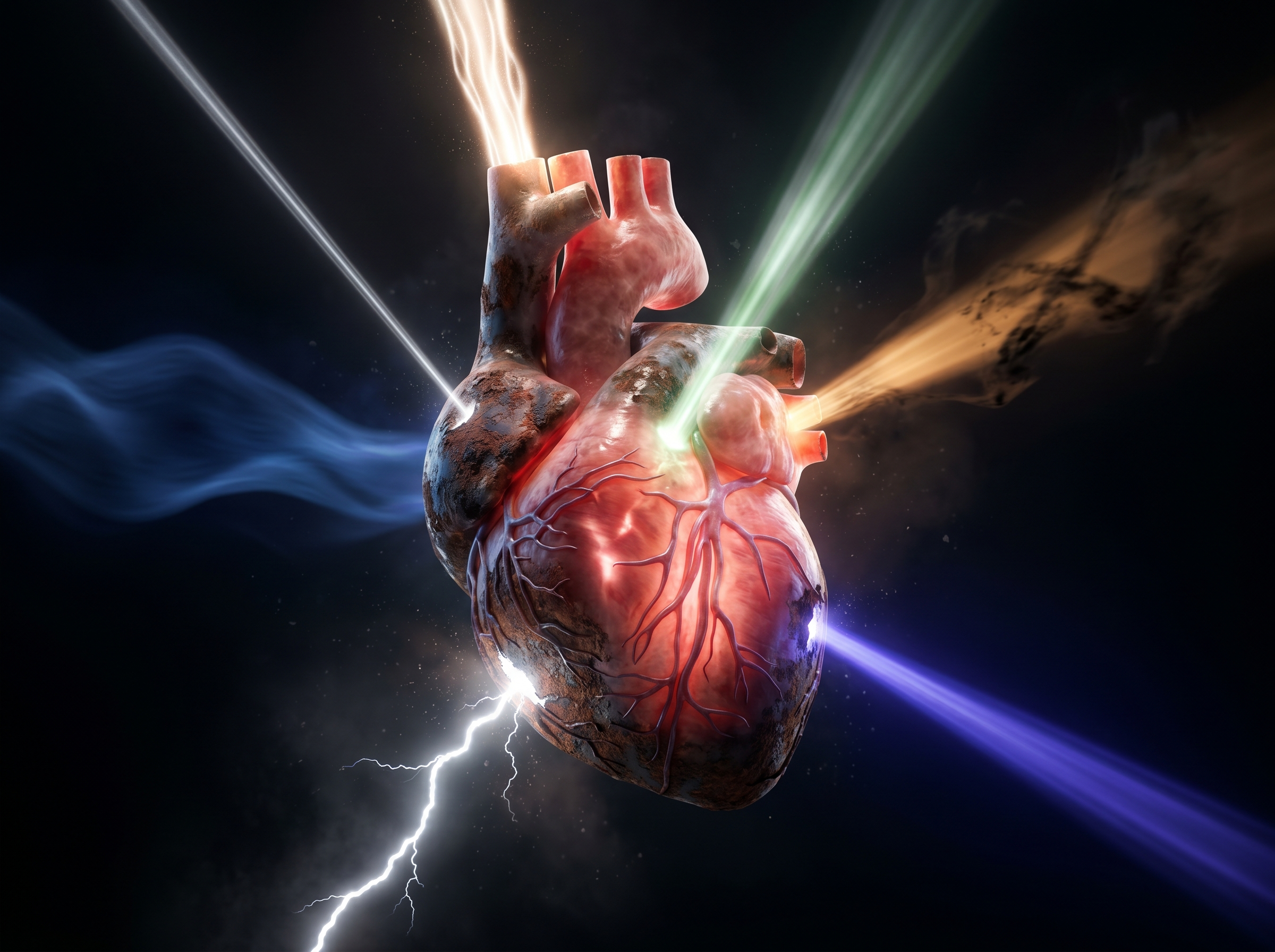
These are not rituals. They are the maintenance protocol for the organ you reason with, create with, and will be questioned about. Every salah you sleepwalk through is a missed maintenance cycle. Every sin you dismiss as minor is another layer of rust on the organ that is supposed to distinguish truth from falsehood.
The full Quranic framework for heart purification — what the Quran calls tazkiya — maps each of these seven channels to specific heart conditions, specific fu’ad functions, and specific stages of spiritual recovery. That framework will be the subject of Part 2.
Looking Inside
We opened with the scholars who failed. The huffaz whose Quran never left their throats. It’s easy to point at them. It’s comfortable to diagnose someone else’s heart.
But the Quran did not reveal these seven pathologies so you could evaluate other people. It revealed them so you could examine yourself. Rust does not announce itself. It accumulates in silence — one lie, one gossip, one moment where you saw injustice and said nothing because speaking would have cost you something. Each one is a layer. And beneath enough layers, the heart that was supposed to reason for you goes quiet.
That is what is wrong with the Muslim world. It is not a lack of knowledge. It’s the hearts that cannot process it. The Quran is there. The hearts are buried.
Part 2 will map the full tazkiya framework — the Quran’s protocol for digging the heart back out. But you do not need Part 2 to begin tonight. You need one charity or a night of sincere tadabbur with the Quran. It starts with a simple step with a pure intention.
A Note on Method
This is tadabbur — personal contemplation of the Quran. It is not classical tafsir, and it does not claim exclusive or final meanings for any verse. The Quran speaks to every community, every era, and every place. Its meanings are not exhausted by any single reading. What I present are observations drawn from cross-referencing the Quran against itself. You verify them against the Book. If what I say aligns with what Allah says, it is from Him. If it falls short, it is from me.
Cross-Reference Index — Full Verses Cited
¹ Hadith — Sahih al-Bukhari 7562; Sahih Muslim 1064 يَخْرُجُ نَاسٌ مِنْ قِبَلِ الْمَشْرِقِ وَيَقْرَءُونَ الْقُرْآنَ لاَ يُجَاوِزُ تَرَاقِيَهُمْ يَمْرُقُونَ مِنَ الدِّينِ كَمَا يَمْرُقُ السَّهْمُ مِنَ الرَّمِيَّةِ “There will emerge people from the East who recite the Quran, but it will not go past their collarbones. They will pass through the religion as an arrow passes through its prey.” Narrated by Abu Sa’id al-Khudri, reported in Sahih al-Bukhari and Sahih Muslim.
Also, from Sahih Muslim (via Abdullah ibn Mas’ud): إِنَّ أَقْوَامًا يَقْرَءُونَ الْقُرْآنَ لاَ يُجَاوِزُ تَرَاقِيَهُمْ وَلَكِنْ إِذَا وَقَعَ فِي الْقَلْبِ فَرَسَخَ فِيهِ نَفَعَ “There are people who recite the Quran but it does not go past their collarbones. But when it settles in the heart and takes root, it benefits.”
² Neuroscience Reference Dr. J. Andrew Armour, Neurocardiology: Anatomical and Functional Principles (1991). Research conducted at UCLA Neurocardiology Research Center. Further developed by the HeartMath Institute (heartmath.org), whose studies confirmed the heart’s intrinsic nervous system contains ~40,000 neurons capable of independent processing, learning, and memory. See: HeartMath Institute, Science of the Heart, Vol. 2 (2015).
³ The Triplet (السَّمْعَ وَالْأَبْصَارَ وَالْأَفْئِدَةَ) — five occurrences:
16:78 وَاللَّهُ أَخْرَجَكُم مِّن بُطُونِ أُمَّهَاتِكُمْ لَا تَعْلَمُونَ شَيْئًا وَجَعَلَ لَكُمُ السَّمْعَ وَالْأَبْصَارَ وَالْأَفْئِدَةَ ۙ لَعَلَّكُمْ تَشْكُرُونَ “Allah brought you out of your mothers’ wombs knowing nothing, and gave you hearing, sight, and af’ida — so that you may be grateful.” — An-Nahl 16:78
23:78 وَهُوَ الَّذِي أَنشَأَ لَكُمُ السَّمْعَ وَالْأَبْصَارَ وَالْأَفْئِدَةَ ۚ قَلِيلًا مَّا تَشْكُرُونَ “It is He who produced for you hearing, sight, and af’ida — yet little are you grateful.” — Al-Mu’minun 23:78
32:9 ثُمَّ سَوَّاهُ وَنَفَخَ فِيهِ مِن رُّوحِهِ ۖ وَجَعَلَ لَكُمُ السَّمْعَ وَالْأَبْصَارَ وَالْأَفْئِدَةَ ۚ قَلِيلًا مَّا تَشْكُرُونَ “Then He proportioned him and breathed into him from His Spirit, and gave you hearing, sight, and af’ida — yet little are you grateful.” — As-Sajdah 32:9
46:26 وَلَقَدْ مَكَّنَّاهُمْ فِيمَا إِن مَّكَّنَّاكُمْ فِيهِ وَجَعَلْنَا لَهُمْ سَمْعًا وَأَبْصَارًا وَأَفْئِدَةً فَمَا أَغْنَىٰ عَنْهُمْ سَمْعُهُمْ وَلَا أَبْصَارُهُمْ وَلَا أَفْئِدَتُهُمْ مِّن شَيْءٍ “We established them in what We have not established you, and gave them hearing, sight, and af’ida. But their hearing, sight, and af’ida availed them nothing.” — Al-Ahqaf 46:26
67:23 قُلْ هُوَ الَّذِي أَنشَأَكُمْ وَجَعَلَ لَكُمُ السَّمْعَ وَالْأَبْصَارَ وَالْأَفْئِدَةَ ۖ قَلِيلًا مَّا تَشْكُرُونَ “Say: It is He who produced you and gave you hearing, sight, and af’ida — yet little are you grateful.” — Al-Mulk 67:23
⁴ Spirit activation — As-Sajdah 32:9 (see ³ above)
⁵ An-Najm 53:11 مَا كَذَبَ الْفُؤَادُ مَا رَأَىٰ “The fu’ad did not lie about what it saw.” — An-Najm 53:11
⁶ Al-Isra’ 17:36 وَلَا تَقْفُ مَا لَيْسَ لَكَ بِهِ عِلْمٌ ۚ إِنَّ السَّمْعَ وَالْبَصَرَ وَالْفُؤَادَ كُلُّ أُولَـٰئِكَ كَانَ عَنْهُ مَسْئُولًا “Do not pursue what you have no knowledge of. Indeed, the hearing, the sight, and the fu’ad — each of those will be questioned.” — Al-Isra’ 17:36
⁷ Al-Humazah 104:6-7 نَارُ اللَّهِ الْمُوقَدَةُ ﴿٦﴾ الَّتِي تَطَّلِعُ عَلَى الْأَفْئِدَةِ ﴿٧﴾ “The fire of Allah, kindled — which peers into the af’ida.” — Al-Humazah 104:6-7
⁸ Al-Baqarah 2:7 خَتَمَ اللَّهُ عَلَىٰ قُلُوبِهِمْ وَعَلَىٰ سَمْعِهِمْ ۖ وَعَلَىٰ أَبْصَارِهِمْ غِشَاوَةٌ ۖ وَلَهُمْ عَذَابٌ عَظِيمٌ “Allah has sealed their hearts and their hearing, and over their sight is a veil. And for them is a great punishment.” — Al-Baqarah 2:7
⁹ Al-Baqarah 2:74 ثُمَّ قَسَتْ قُلُوبُكُم مِّن بَعْدِ ذَٰلِكَ فَهِيَ كَالْحِجَارَةِ أَوْ أَشَدُّ قَسْوَةً “Then your hearts hardened after that, being like stones or even harder.” — Al-Baqarah 2:74
¹⁰ Al-Baqarah 2:10 فِي قُلُوبِهِم مَّرَضٌ فَزَادَهُمُ اللَّهُ مَرَضًا “In their hearts is disease, and Allah has increased their disease.” — Al-Baqarah 2:10
¹¹ Al-Mutaffifin 83:14 كَلَّا ۖ بَلْ ۜ رَانَ عَلَىٰ قُلُوبِهِم مَّا كَانُوا يَكْسِبُونَ “No! Rather, what they have earned has rusted over their hearts.” — Al-Mutaffifin 83:14
¹² Al-Hajj 22:46 (see full verse at Section 2 header)
¹³ Muhammad 47:24 أَفَلَا يَتَدَبَّرُونَ الْقُرْآنَ أَمْ عَلَىٰ قُلُوبٍ أَقْفَالُهَا “Do they not contemplate the Quran, or are there locks upon their hearts?” — Muhammad 47:24
¹⁴ Ar-Ra’d 13:28 أَلَا بِذِكْرِ اللَّهِ تَطْمَئِنُّ الْقُلُوبُ “Verily, in the remembrance of Allah do hearts find tranquility.” — Ar-Ra’d 13:28
If this reached you, share it with someone whose heart needs to hear it.
Peace,
Roohle — Activate Your Spirit. Escape the Dajjal System. Return to Allah.
Stay with the work
A short letter, when there is something worth sending.
No schedule. No marketing. A note when a new piece is published, sometimes a passage being worked through, occasionally nothing for weeks. Roughly once a month.