Maps · / /
The Adam Archetype — Why We're All Chasing Immortality and Power
Adam had everything he needed. One prohibition. He broke it. The Quran records why — and the reason is you.
The 8 Prophetic Archetypes
I traced eight prophets through the Quran and found that their lives don't just describe history. They describe you.
Each prophet represents an awareness stage — a specific threshold of human development that every person seeking to return to Allah must cross. In sequence. You cannot jump from Adam's awareness to Ibrahim's1 عليه السلام without passing through what comes between them. The stages build on each other. Miss one and the structure doesn't hold.
These are the eight stages, in order:
Adam عليه السلام — The Vulnerable Human
Idris عليه السلام — The Spiritual Scholar
Nuh عليه السلام — The Self-Expressive Hero
Ibrahim عليه السلام — The Surrenderer
Musa and Harun عليهما السلام — The Communicative Leaders
Dawud and Sulayman عليهما السلام — The Powerful Visionaries
Isa ibn Maryam عليه السلام — The Creative Altruist
Muhammad ﷺ — The Leader of Leaders
These eight are the spine. The journey toward meeting Allah with a mature and tranquil nafs2 runs through all of them. Think of them as a staircase. You begin where Adam began. You end where the Prophet ﷺ arrived.
This article is Stage 1.
Stage 1 — Adam عليه السلام: The Vulnerable Human
وَإِذْ قَالَ رَبُّكَ لِلْمَلَـٰٓئِكَةِ إِنِّى جَاعِلٌ فِى ٱلْأَرْضِ خَلِيفَةً ۖ قَالُوٓاْ أَتَجْعَلُ فِيهَا مَن يُفْسِدُ فِيهَا وَيَسْفِكُ ٱلدِّمَآءَ وَنَحْنُ نُسَبِّحُ بِحَمْدِكَ وَنُقَدِّسُ لَكَ ۖ قَالَ إِنِّىٓ أَعْلَمُ مَا لَا تَعْلَمُونَ
And when your Lord said to the angels: "I am placing a khalīfah on the earth." They said: "Will You place there one who will spread corruption and shed blood, while we glorify Your praise and sanctify You?" He said: "I know what you do not know."
Before the fall, there was an arrangement. Allah placed Adam عليه السلام in Paradise with two guarantees — food and safety, not power, not immortality — just the two things any human being actually needs.3 And one prohibition alongside them.
The Quran does not specify what the tree was.4 Read that again. Allah calls it "this tree" — not the tree of X, not the tree of Y. As if Allah is saying: the type does not matter. The command is the point.
We treat that same principle as optional. We want to understand the reason before we follow the command. Adam عليه السلام had to learn that the prohibition stands on its own authority — it does not need our understanding. That is the first lesson of Stage 1. It is the first lesson you need to learn too.
The Quran doesn't tell you what the tree was. That is deliberate.
The tree does not matter. The command matters.
The Two Things You Are Always Chasing
Before the fall, there was a whisper. To understand the whisper, you need to understand what it targeted.
Allah designed the human being with two foundational drives. Every choice you make, every ambition you pursue, every relationship you enter — underneath it, at the base, one of these two drives is operating.
The first: immortality. You don't want to die. Not just biologically — you want to matter beyond your biological end. You want to leave something that outlasts you. Achievement, legacy, children, status, fame — at the core of all of it is a refusal to accept that you will end. You were built this way. The desire itself is not the problem.
The second: eternal power. You don't want to be seen as limited. So you hide the vulnerabilities, accumulate authority, validation, influence — anything that holds exposure at a distance. Leadership, community, social positioning — underneath all of it is the same drive: do not let them see that I am insufficient.
Satan understood these two drives completely. So he didn't tempt Adam عليه السلام with something new. He named what Adam عليه السلام already wanted.
The Whisper
فَوَسْوَسَ إِلَيْهِ ٱلشَّيْطَـٰنُ قَالَ يَـٰٓادَمُ هَلْ أَدُلُّكَ عَلَىٰ شَجَرَةِ ٱلْخُلْدِ وَمُلْكٍ لَّا يَبْلَىٰ
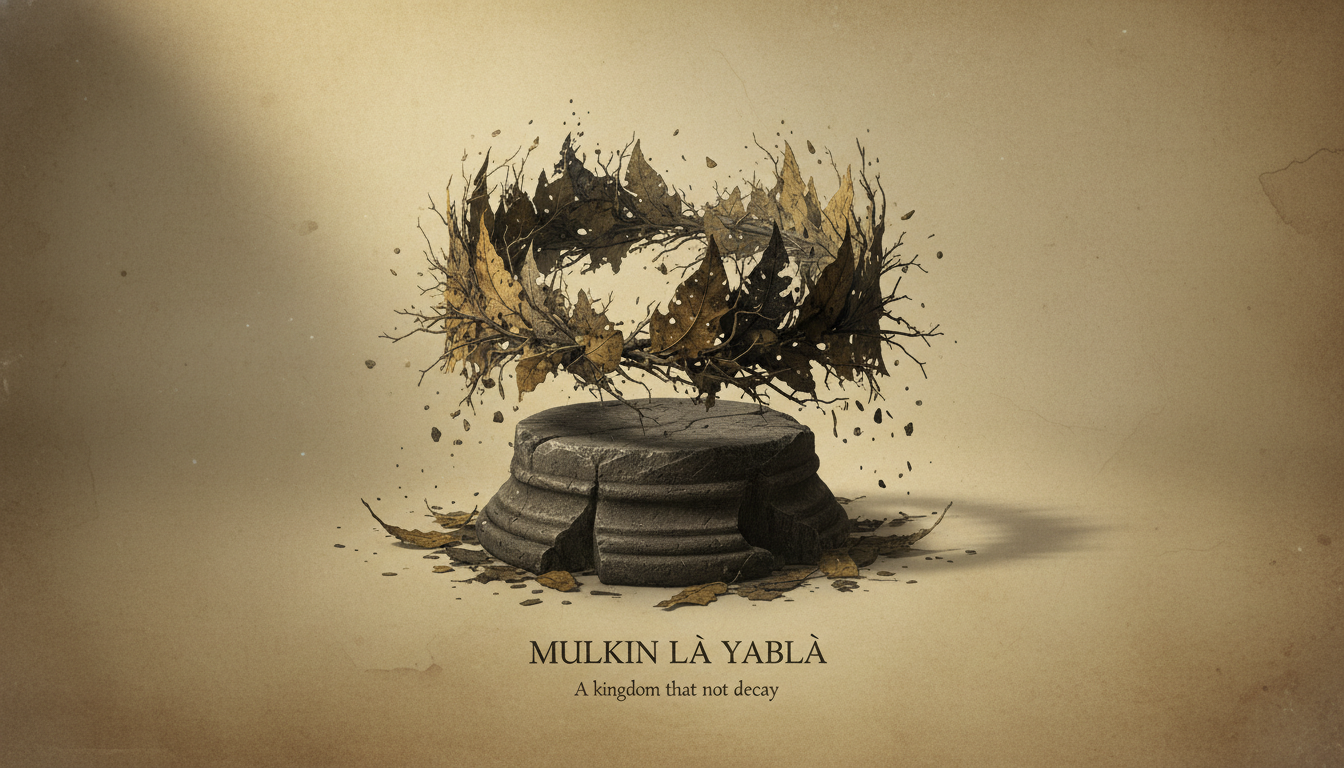
Then Satan whispered to him and said: "O Adam, shall I direct you to the tree of immortality and a kingdom that does not decay?"
One sentence. Two desires, named with surgical precision.
Shajarat al-khuld — the tree of immortality. Mulkin lā yablā — a kingdom that does not decay. Satan didn't invent new wants in Adam. He looked at what was already there and handed it back to him with a label on it.
That is how the enemy operates. He doesn't introduce new temptations. He identifies what is already in you and frames the forbidden thing as the answer to it.
Every significant decision in your life arrives with a variation of that same whisper. The new opportunity. The thing everyone around you is doing. The lifestyle that promises status, belonging, lasting impact. The question underneath all of it: shall I show you something that will extend your power and your legacy?
The question isn't evil. The desire isn't either — Allah put it there. What matters is what you trade to answer it.
Take alcohol as one example. The reason most people start is not the taste. It is what alcohol promises — belonging, confidence, social power. The industry has built an entire mythology around it: this drink marks you as someone who has arrived, someone who fits into this culture, this class, this occasion. It targets the desire for eternal power directly. The full Quranic case against it — the four-stage prohibition, the mechanism of spiritual disconnection, the rijs — is laid out in the alcohol article. The point here is the mechanism. Satan always frames the forbidden thing as the answer to one of the two desires. The offer sounds like an upgrade. The tree seems like it might actually work.
What Happened When Adam Answered
They ate. And what was promised did not come — not immortality, not the kingdom that does not decay. What came instead was the exact thing both desires had been built to outrun.5
Their vulnerabilities were exposed. Completely. Instantly. The very thing the drive for eternal power was trying to keep hidden — nakedness, limitation, insufficiency — was what the act produced.
Every sin built on this pattern follows the same structure.
Reach for immortality. Get the exposure of everything you were trying to hide.
Allah guaranteed Adam what he needed. When you reach for more than that through the forbidden, you don't ascend. The structure collapses inward. Every time.
The Return
ثُمَّ ٱجْتَبَـٰهُ رَبُّهُۥ فَتَابَ عَلَيْهِ وَهَدَىٰ
Then his Lord chose him and turned to him in forgiveness and guided him.
The story does not end with the fall. That is crucial.
Adam عليه السلام recognized what happened. He didn't explain it or rationalize it. He turned back. And Allah chose him, accepted his return, and guided him.
He entered the story as someone who had everything and did not understand what he had. He came out as someone who understood what loyalty to Allah's command actually costs — and chose it anyway. That transformation is the Adam archetype. Not the sin. The recognition after it.
You are built with these two desires. You will be tested through them — the whisper comes in different forms, but the structure never changes. The question is whether you recognize it before you answer it, or only after.
Either way, it is never too late to return. That is not a consolation. That is the map.
Stage 2 is Idris عليه السلام — what happens when the human being, having recognized his vulnerability, turns toward knowledge.
إِنِّى جَاعِلٌ فِى ٱلْأَرْضِ خَلِيفَةً
"I am placing a khalīfah on the earth." The root kh-l-f carries succession and coming after. The angels asked a question about this appointment — not an objection, but a genuine inquiry. Allah's response — "I know what you do not know" — closes the inquiry without answering it. The answer unfolds through Adam's story itself.
Q. 2:30 · Sūrah al-Baqarah · Madanī
يَـٰٓأَيَّتُهَا ٱلنَّفْسُ ٱلْمُطْمَئِنَّةُ ٱرْجِعِىٓ إِلَىٰ رَبِّكِ رَاضِيَةًۭ مَّرْضِيَّةًۭ
"O tranquil nafs — return to your Lord, well-pleased and well-pleasing." The destination the eight stages point toward. The three Quranic states of the nafs — ammārah (12:53), lawwāmah (75:2), muṭma'innah (89:27–28) — form a developmental arc. Stage 1 begins at the first; the staircase ends at the third.
Q. 89:27–28 · Sūrah al-Fajr · Makkī
إِنَّ لَكَ أَلَّا تَجُوعَ فِيهَا وَلَا تَعْرَىٰ · وَأَنَّكَ لَا تَظْمَأُ فِيهَا وَلَا تَضْحَىٰ
"Indeed, for you in it is that you will not be hungry, nor will you be unclothed. And you will not be thirsty, nor will you be exposed to the sun." Allah did not promise Adam greatness. He promised sufficiency. The desire for more than sufficiency is where the test began.
Q. 20:118–119 · Sūrah Ṭāhā · Makkī
وَلَا تَقْرَبَا هَـٰذِهِ ٱلشَّجَرَةَ فَتَكُونَا مِنَ ٱلظَّـٰلِمِينَ
"Do not approach this tree, lest you both become of the wrongdoers." The Quran uses the demonstrative hādhihi — this tree — rather than naming it. The specific tree is irrelevant. The command is what holds the moral weight.
Q. 2:35 · Sūrah al-Baqarah · Madanī
فَوَسْوَسَ إِلَيْهِ ٱلشَّيْطَـٰنُ قَالَ يَـٰٓادَمُ هَلْ أَدُلُّكَ عَلَىٰ شَجَرَةِ ٱلْخُلْدِ وَمُلْكٍ لَّا يَبْلَىٰ
"Then Satan whispered to him and said: O Adam, shall I direct you to the tree of immortality and a kingdom that does not decay?" The root w-s-w-s is onomatopoeic — it sounds like a whisper. Shajarat al-khuld and mulkin lā yablā name the two foundational human desires precisely. Satan did not introduce new wants. He identified what was already there.
Q. 20:120 · Sūrah Ṭāhā · Makkī
فَأَزَلَّهُمَا ٱلشَّيْطَـٰنُ عَنْهَا فَأَخْرَجَهُمَا مِمَّا كَانَا فِيهِ
"Then Satan caused them to slip from it and removed them from that in which they had been." The verb fa-azallahumā from root z-l-l — a foot losing its footing, not a push. Satan did not drag them. He arranged the conditions for the slip. Then came the descent.
Q. 2:36 · Sūrah al-Baqarah · Madanī
ثُمَّ ٱجْتَبَـٰهُ رَبُّهُۥ فَتَابَ عَلَيْهِ وَهَدَىٰ
"Then his Lord chose him and turned to him in forgiveness and guided him." Three verbs in sequence: ijtabāhu (chose him, drew him close), tāba 'alayhi (turned to him — tawbah in its active verbal form), hadā (guided him). Allah chose him first. The return and the guidance came after that choosing.
Q. 20:122 · Sūrah Ṭāhā · Makkī
Stay with the work
A short letter, when there is something worth sending.
No schedule. No marketing. A note when a new piece is published, sometimes a passage being worked through, occasionally nothing for weeks. Roughly once a month.